
What the morning after a storm actually looks like
When wind or hail moves through Moore, Norman, Oklahoma City, or any of the surrounding towns in the metro, the damage isn't always obvious from the driveway. A roof can take a real hit and still look fine from thirty feet away, which is exactly why a lot of homeowners miss the early signs. The morning after is the best time to look, while the storm's path is fresh and you still remember which way the wind was blowing.
This isn't about climbing a ladder or playing adjuster. It's a twenty to thirty minute walk around your own property with your eyes open and your phone camera ready. What you find, or don't find, tells you whether this is a wait-and-watch situation or one where you pick up the phone today.
Why small storm damage doesn't stay small
A cracked seal, a lifted shingle tab, or a dented flashing strip rarely causes a leak on day one. The problem shows up weeks or months later, after rain has had repeated chances to work its way under a loosened edge. By the time a ceiling stain appears inside the house, water has usually been getting in for a while already.
What wind does differently than hail
Wind tends to lift and pry. It gets under a shingle edge and works it loose, or it peels back a section along a ridge or rake edge where the wind catches hardest. You'll often see missing pieces in the yard, torn screens, or a fence panel knocked loose before you see anything wrong up top.
Hail works differently. It bruises and cracks rather than lifting, and it hits soft metal just as hard as shingles. That's why vent caps, flashing, and gutters are some of the fastest ways to gauge hail impact from the ground, since dents on those surfaces show up clearly even when shingle granule loss is harder to spot.
Why gutters tell on a storm fast
Gutters are thin metal hung at the edge of the roofline, so they take impact the same way a hood or fender does. A hailstorm that leaves shingles looking mostly fine will often leave gutters covered in small dents, especially on the side that faced the wind.
That's useful information even if you never plan to replace the gutters. Dent patterns on a gutter run are a rough map of how hard the same storm hit the roof surface just above it, which is one more reason a careful look at the gutters belongs on this checklist.
| Area | Wind damage signs | Hail damage signs |
|---|---|---|
| Shingles | Lifted tabs, missing pieces, exposed nail heads | Dark bruised spots, granule loss, soft divots |
| Gutters | Pulled away from fascia, bent sections | Rows of small round dents, especially on one side |
| Soft metal and vents | Bent or torn caps, loosened flashing | Dents and dings across exposed surfaces |
| Yard and siding | Branches, debris, torn screens | Dented siding, cracked window screens |
What's actually up there: the parts you're checking
You don't need to know roofing terminology to do this walk-around, but it helps to know what you're looking at. Shingles are the outer layer, flashing is the thin metal that seals edges and transitions, soft metals cover vents and pipe boots, and the attic is your best window into what's happening underneath it all without ever going outside.
If your home has a skylight, that's one more spot worth a second look, since the seal around a skylight is a common place for wind-driven rain to find its way in after a storm has already loosened things up a bit.
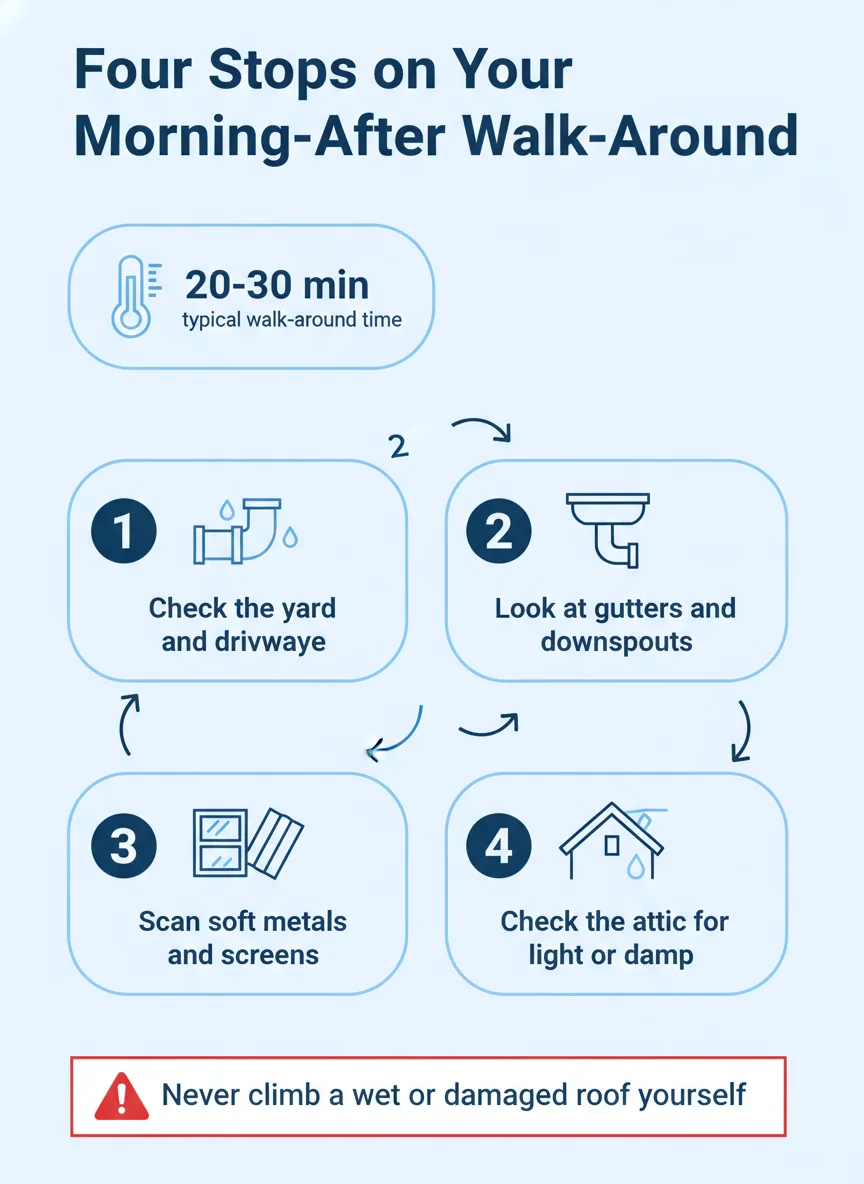
Step-by-step: your morning-after walk-around
Work through these in order, starting at ground level and working your attention upward. Keep your phone out the whole time, since photos taken right after a storm are more useful than ones taken a week later.
- Walk the yard first: Look for shingle granules, torn pieces, bent vent caps, or chunks of soft metal on the ground, driveway, and in gutters that have overflowed onto the lawn.
- Check gutters and downspouts: Scan for dents, sections pulled from the fascia, and downspouts bent or knocked loose at a joint or elbow.
- Scan the roofline with binoculars: From the ground or a second-story window, look for shingle tabs that look lifted, curled, or missing along ridges and edges.
- Check screens and soft siding: Torn window screens or dented siding on one side of the house usually mean the roof on that same side took similar impact.
- Go up to the attic: Bring a flashlight and look for daylight coming through the roof deck, damp insulation, or water stains along the rafters.
- Photograph everything you find: Take wide shots and close-ups of each area, note the date, and keep them together in one folder in case you need them later.
- Call for a closer look: If you found anything on this list, or you're not sure, get an experienced set of eyes on it before the next rain.
What your findings are telling you
A clean walk-around with no granules, no dents, and a dry attic is genuinely good news, and plenty of storms pass through without leaving a mark. But finding even one or two items on this list is worth taking seriously, because roof damage rarely improves on its own between now and the next rain.
Signs that point to repair
A handful of lifted shingles, a dented section of gutter, or a small amount of granule loss in one spot are usually things a roof repair visit can take care of in a single trip. These are targeted fixes to specific areas rather than whole-roof problems.
The same goes for flashing around a chimney, vent, or skylight that looks bent or pulled away but hasn't let water through yet. Catching it at this stage is almost always less disruptive than waiting for a leak to force the issue.
Signs that point to a bigger conversation
Daylight visible through the attic deck, widespread granule loss across multiple slopes, or a roof that's already near the end of its expected life are different situations. If your storm and hail damage assessment turns up damage across a large portion of the roof rather than a few isolated spots, that's worth a full evaluation rather than a patch.
Either way, a prompt assessment gives you options. Waiting tends to narrow them, since a roof that's taken on hidden moisture for a few extra weeks can turn a repair into something larger.
What you can check yourself and what needs a pro
Everything on the walk-around checklist above is safe and reasonable for a homeowner to do alone: walking the yard, scanning with binoculars, checking the attic with a flashlight, and taking photos. None of it requires getting on the roof, and all of it gives you useful information to act on.
Where it makes sense to bring in a licensed roofer is anything that requires actually getting up on the surface, identifying hail bruising that isn't visible from the ground, or judging how deep flashing or decking damage goes. Those calls take training and the right safety setup, and getting them wrong either way, missing real damage or over-reporting minor wear, costs you time or money down the line.
A good assessment also documents what's found in a way that holds up if you end up filing an insurance claim, which is harder to do well from a smartphone and a ladder on your own.
Make the walk-around a habit, not a one-time thing
Storms move through the metro often enough that this checklist is worth keeping somewhere you'll remember it, not just reading once and forgetting. A quick walk-around after every significant wind or hail event, paired with regular roof maintenance between storms, catches small problems while they're still small and cheap to fix.
If your walk-around turns up anything that gives you pause, reach out and All The Way Up Construction will take it from there.
Frequently asked questions
What should I look for on the ground after a storm?
Start with granules, shingle pieces, and any small dents in soft metal like vent covers or window screens. Granules collecting at the base of a downspout or in the yard often mean the shingles up top took a beating, even if you can't see it from the ground.
How do I know if my gutters were damaged in a storm?
Look for gutters pulled away from the fascia, dents along the top edge, and downspouts that are bent, crimped, or disconnected at a joint. Run a hose through a section if you're unsure. Standing water or overflow at a seam usually points to a clog or a new dent.
Is it safe to check my own roof after a storm?
Walking the yard and using binoculars from the ground is safe and is exactly how most homeowners should start. Climbing onto a wet roof, a roof with hidden soft spots, or one with downed lines nearby is not worth the risk, so leave the close-up look to someone experienced.
Should I call my insurance company before or after a roofer looks at the damage?
Either order can work, but having a roofer's documentation in hand before you file often makes the claims conversation smoother. A written assessment with photos gives the adjuster something concrete to review alongside whatever you report yourself.
How soon after a storm should I get a roof looked at?
Sooner is better, especially if you saw granules, dented metal, or any sign of water inside the house. Damage that looks minor on day one can let moisture in over the following weeks, so a prompt look limits how far a small problem spreads.