
Why storm prep matters in the Oklahoma City metro
Spring and early summer bring a stretch of unpredictable weather to Moore, Norman, and the rest of the Oklahoma City metro, with storms that can go from a line of thunderheads to large hail or high wind gusts in under an hour. Forecasts give you a window, sometimes a day, sometimes just a few hours, and what you do with that window matters more than people think.
A five-minute walk-around before the weather hits doesn't stop a storm from doing damage, but it puts you in a far better spot afterward. You'll have a clear before-and-after record, loose items won't become projectiles against your siding or windows, and you'll know exactly where to look the next morning instead of guessing.
What actually happens to a roof during a storm
Most storm damage in this region comes from one of two things: wind lifting or tearing shingles at the edges and ridges, or hail impacting the surface hard enough to bruise or crack the shingle mat. Both tend to start small and get worse with the next storm if nobody catches it.
Wind damage and why edges go first
Wind doesn't usually peel shingles from the middle of a slope first. It works at the edges, the ridge line, and anywhere flashing meets a different material, like around a chimney or a skylight. Those are the spots with the least surface area holding the material down, so they're the first to lift when a gust gets underneath.
That's part of why a pre-storm check should include a look at your roofline from the ground for anything already lifted or curling. A shingle that's already loose before the storm is far more likely to tear off completely once the wind hits, and catching it early with a repair is a smaller job than catching it after.
Hail damage and why it's easy to miss
Hail bruises the shingle mat without always breaking through it, so from the ground it can look like nothing happened even when the material underneath has lost some of its protection. That's why the after-storm check matters as much as the before-storm one, and why granules showing up in your gutters or downspouts after a hailstorm is worth paying attention to.
Hail damage also tends to show up worse on one side of the roof, usually whichever direction the storm came from. If you're comparing your before and after photos and one slope looks different from the others, that's the slope to have a closer look at first.
| Situation | Before the storm | After the storm |
|---|---|---|
| Gutters | Clear leaves and debris so water has somewhere to go | Check for granules collecting at the downspout |
| Roofline | Photograph from all four sides as a baseline | Compare against the photos for lifted or missing shingles |
| Yard items | Secure or store loose furniture, toys, and trash cans | Check for anything that moved and where it landed |
| Trees | Trim branches hanging over the roof or near the house | Look for broken limbs resting on the roof or gutters |
The parts of your home that take the brunt of a storm
The roof surface gets most of the attention, but a few other spots matter just as much when a storm comes through. Gutters and downspouts handle the volume of water coming off the roof, and if they're clogged, that water finds the path of least resistance, which is sometimes under the shingle edge or behind the fascia board.
Anything that penetrates the roof, meaning vents, chimneys, and skylights and flashing, relies on a seal that can work loose over time or get stressed further by wind. These spots are worth a visual check from the ground before a storm and a closer look after one, since a small gap here is often where a leak starts even though the shingles themselves look fine.
Step-by-step: your pre-storm roof checklist
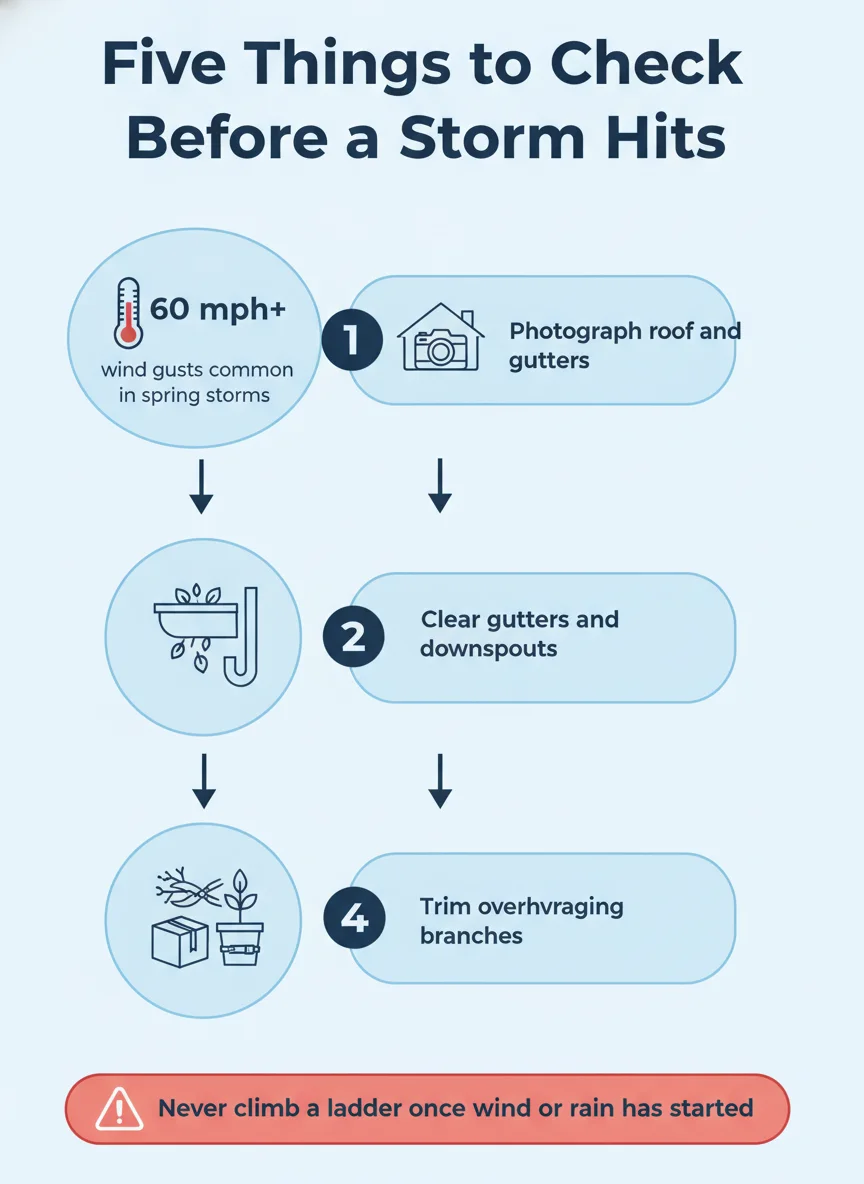
Run through this list once you see a storm in the forecast, ideally the night before or the morning of, while the weather is still calm and a ladder is still safe to use.
- Photograph the roof: Take pictures from all four sides of the house and, if you can safely do so, a few from an upstairs window. This is your before record.
- Clear gutters and downspouts: Pull out leaves, sticks, and shingle grit so rainwater has a clear path off the roof instead of backing up at the edge.
- Secure loose outdoor items: Bring in or tie down patio furniture, trash cans, toys, and anything light enough for wind to pick up and throw against the house.
- Trim overhanging branches: Cut back any limbs hanging directly over the roof. A branch that snaps in high wind can crack shingles or puncture decking on the way down.
- Know your attic access: Make sure you know where the attic hatch is and can get to it quickly if you need to check for a leak during or after the storm.
- Know your water shutoff: Locate the main water shutoff valve ahead of time. If a storm causes damage that affects plumbing near the roofline, you'll want to act fast.
- Check forecasted wind direction: Note which side of the house will take the brunt of the wind. That's the side to check first once the storm passes.
What to look for the morning after
Once the storm has passed and it's safe to be outside, walk the perimeter of the house and compare what you see against your before photos. This is where most people catch damage early, before it turns into a leak that shows up on the ceiling weeks later.
Signs to check from the ground
Look for shingles that are missing, curled up at the edges, or visibly out of line with the rest of the slope. Check gutters and the ground below downspouts for a buildup of granules, which can mean the hail or wind has worn through the protective surface layer on the shingles.
Also check vent covers, chimney flashing, and any skylight trim for dents or gaps that weren't there before. These smaller components are easy to overlook but are often where a leak actually starts.
Signs to check from inside
Head up to the attic with a flashlight and look for new water stains, damp insulation, or daylight coming through anywhere it shouldn't. Ceiling stains downstairs are usually the last sign to show up, so catching it in the attic first buys you time before it becomes a bigger repair.
If you find anything that concerns you, whether it's a stain, a soft spot, or shingles you can see are out of place from your photos, it's worth getting a second set of eyes on it. A roof repair visit after a storm, even a small one, is far cheaper than letting water sit against decking for weeks.
What you can handle yourself and when to call a professional
The prep side of this checklist, meaning photos, gutter clearing, securing loose items, and trimming low branches, is all reasonable for a homeowner to handle without special equipment. None of it requires getting on the roof itself, and most of it takes less time than people expect once it's part of a routine before storm season.
The after-storm side is where it's worth being more careful. A visual check from the ground or attic is fine to do yourself, but actually walking the roof surface to assess storm and hail damage up close is a job for someone with the right footing and experience, especially on a wet or uneven surface.
If you're ever unsure whether what you're seeing is cosmetic or something that needs attention, it's reasonable to get a professional opinion rather than guess. A trained eye can usually tell within a few minutes whether a slope needs a repair or whether it's holding up fine.
Make storm prep part of your routine
None of this checklist is complicated, but it only works if it becomes a habit you run through every time a storm shows up in the forecast rather than something you think about after the fact. Keep a copy of your before photos somewhere easy to find, like your phone's camera roll, so you're not hunting for them the morning after.
For homeowners in Moore and across the Oklahoma City metro, a five-minute check before the weather arrives and a careful walk-around the next morning is the simplest way to catch a problem while it's still small, and All The Way Up Construction is here if that walk-around turns up something worth a closer look.
Frequently asked questions
How much time do I need to prep my roof before a storm?
A basic walk-around checklist takes most homeowners about five to ten minutes if the yard and gutters are already in decent shape. It takes longer the first time, since you're also taking baseline photos and checking things like attic access that you won't need to recheck every storm.
Should I take pictures of my roof before every storm?
Yes, a quick photo set from the ground on all four sides gives you a before record if damage happens. It costs nothing and takes a couple of minutes, and it's the single easiest thing to compare against after the storm passes.
What should I check on my roof the morning after a storm?
Look from the ground for missing or curled shingles, dented vents or flashing, and granules collecting in gutters or downspouts. Check the attic for new water stains, and if you see any of these, a [roof repair](/services/roof-repair) inspection is worth scheduling before a small issue turns into a leak.
Do I need to clear my gutters before every storm, or just once a season?
Clogged gutters matter most right before heavy rain, since standing water has nowhere to go and can back up under the edge of the roof. A quick check before a forecasted storm, even if you cleaned them a few weeks earlier, catches debris that built up since.
Is it safe to go on the roof before a storm to check it?
It's safer to do your storm prep checklist from the ground or from a ladder at the gutter line rather than walking the roof surface itself. Once wind picks up or rain starts, stay off the ladder entirely and wait for calm weather or a professional to take a closer look.