
What a Workmanship Warranty on a New Roof Actually Means
If you've had a roof replaced anywhere in the Oklahoma City metro, you've probably heard the word warranty thrown around a lot. It sounds reassuring, but most homeowners never actually read what it promises. A workmanship warranty is a written commitment from the company that installed your roof, covering problems caused by how the work was done, not problems with the shingles themselves.
This matters more in Oklahoma than in a lot of places, because the state swings between ice, high wind, and summer heat in the same calendar year. A roof that's installed correctly handles that cycling fine for decades. One with a flashing detail done wrong or a nail pattern that's off will usually show it within the first few seasons, which is exactly the window a workmanship warranty is built to cover.
How a Workmanship Warranty Actually Works
A workmanship warranty is separate from the warranty that comes from the shingle manufacturer. The manufacturer stands behind the materials, meaning defects in the shingles themselves. The roofer who installed them stands behind the labor, meaning leaks or problems traced back to how the roof went on. Both documents exist at the same time on the same roof, and a good contractor will explain both before you sign anything.
What It Covers
Our workmanship warranty runs 5 years and covers leaks or defects that trace back to our installation. If a flashing detail wasn't sealed right, a seam around a vent opens up, or a nail pattern causes a shingle to lift early, that falls under workmanship. It's in writing, and it transfers to the next owner if you sell the home, which is a detail a lot of warranties leave out.
The idea behind a workmanship warranty is simple: if we made a mistake installing your roof, we come back and fix it at no cost to you. It's not an upsell or an add-on. It's a basic accountability measure that should come standard with any roof replacement in this region.
What It Does Not Cover
A workmanship warranty doesn't cover storm damage, hail impact, or wind events strong enough to tear shingles loose on a properly installed roof. Those situations are what homeowner's insurance is for, and a roofer can usually help document the damage, but the workmanship warranty itself isn't the mechanism that pays for that kind of repair.
It also doesn't cover normal wear over time. Shingles age under Oklahoma sun and temperature swings no matter how well they're installed, and that gradual breakdown is a materials and lifespan issue, not an installation defect. If you're not sure which category a problem falls into, that's exactly the kind of call worth making before you assume anything is or isn't covered.
| Coverage Type | Who Stands Behind It | What It Typically Covers |
|---|---|---|
| Workmanship warranty | The roofing contractor | Leaks or defects traced to the installation itself |
| Manufacturer warranty | The shingle manufacturer | Defects in the shingles or materials themselves |
| No warranty at all | No one | Any repair becomes an out-of-pocket cost, regardless of the cause |
The Parts of a Roof a Workmanship Warranty Actually Protects
The spots that fail from installation error tend to be the same spots every time: flashing around chimneys and vents, the seal around skylights, valleys where two roof planes meet, and the starter courses along the edges. These are the detail-heavy parts of a roof where a rushed or inexperienced crew leaves gaps, and they're exactly what a workmanship warranty is designed to catch.
Open field shingles, the big flat expanses in the middle of a roof plane, rarely cause workmanship claims because there's less technique involved in laying them down. It's the transitions, penetrations, and edges that separate a roof that lasts from one that leaks in year two, which is part of why we treat those details carefully on every install.
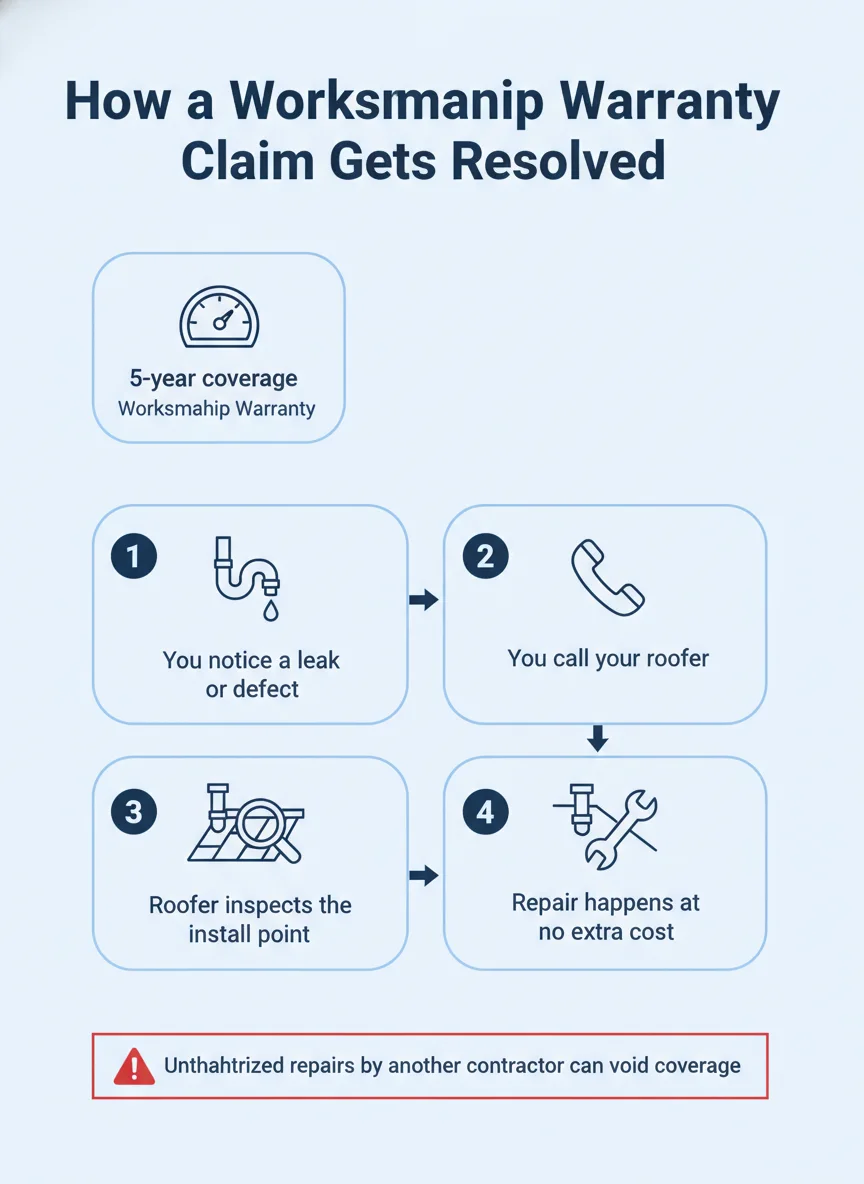
Step-by-step: What Happens If You File a Warranty Claim
Filing a workmanship claim isn't complicated, but knowing the sequence ahead of time keeps the process moving faster when you actually need it.
- Spot the problem: A water stain on a ceiling, a damp spot in the attic, or a shingle lifting at a seam is usually the first sign something needs a look.
- Call your roofer: Reach out to whoever installed the roof and describe what you're seeing and where in the house it's showing up.
- Schedule an inspection: A tech checks the install points most likely to cause the issue, like flashing, valleys, and seams, rather than the whole roof.
- Get a diagnosis: The roofer tells you whether the cause falls under workmanship, under the manufacturer warranty, or outside both.
- Repair happens: If it's a workmanship issue, the fix is made at no cost to you under the terms of the warranty.
- Documentation is kept: A record of the repair should be kept on file in case the same spot ever needs attention again.
What You'll Find When a Claim Gets Reviewed
Issues That Qualify
A leak that shows up near a penetration point, like a vent pipe or chimney, within the warranty period is one of the clearest cases. Same with a seam that opens along a valley or a starter course that pulls loose along an edge. These are install-quality issues, and they're what the warranty exists to fix.
Shingles that lift in a pattern consistent with incorrect nailing, rather than random storm damage, also typically qualify. The giveaway is usually the pattern: workmanship issues tend to cluster around specific details rather than spreading evenly across the whole roof.
Issues That Don't Qualify
Damage from a specific wind or hail event, even if it happens the week after installation, generally falls outside workmanship coverage because the cause is the weather, not the install. That's an insurance conversation, and it's worth getting familiar with how that process works before you need it.
Problems caused by another contractor working on the roof after the original install, like a satellite dish mount or a vent added later, also usually fall outside the original warranty. That's part of why it matters who touches your roof after the first install is done.
DIY vs Calling a Pro on a Warranty Issue
There's very little a homeowner should attempt directly when it comes to a potential workmanship issue. Climbing up to look at a flashing seam or a valley without the right footing and equipment is a real fall risk, and poking at a seam that's already failing can make a small leak into a bigger one before anyone's even diagnosed the cause.
What you can do is keep an eye on the signs from the ground or the attic. A water stain, a musty smell, daylight coming through a roof deck seam, or a shingle that looks lifted from the yard are all worth a phone call. Writing down when you first noticed it and where in the house it's showing up gives whoever inspects it a head start.
The actual inspection and repair should go to whoever holds the warranty, since bringing in an outside contractor can complicate or void the claim entirely. A roofer licensed to work in Oklahoma will know how to trace a leak back to its actual source, which is often several feet from where the water shows up inside the house.
Why a Written Warranty Is Worth Asking About Before You Sign
Any roofer can tell you they stand behind their work. A written workmanship warranty is what turns that into something you can actually hold them to. Before hiring anyone for a roof replacement in Moore, Norman, Oklahoma City, or anywhere in the metro, it's worth asking exactly how long their workmanship coverage runs and what it includes in writing, not just what gets said on the phone.
A 5-year workmanship warranty that transfers to the next owner is a meaningful commitment, not just paperwork, and it's the kind of detail that should factor into who you hire just as much as material choice does. All The Way Way Up Construction puts that coverage in writing on every roof replacement we install.
Frequently asked questions
How long is a workmanship warranty on a new roof?
It depends on the roofer, but a 5-year workmanship warranty, like the one we offer, is a solid middle ground for the industry. Some contractors offer shorter terms or none at all, so it's worth asking before you sign anything.
Does a workmanship warranty cover storm or hail damage?
No, a workmanship warranty covers defects in how the roof was installed, not damage from weather events. Storm and hail damage is typically handled through your homeowner's insurance policy instead.
What's the difference between a workmanship warranty and a manufacturer warranty?
A workmanship warranty covers the labor and install quality, while a manufacturer warranty covers defects in the shingles or materials themselves. We cover more of this split in our post on [manufacturer vs workmanship warranty coverage](/blog/manufacturer-warranty-vs-workmanship-warranty-who-covers-what).
Does a roof warranty transfer if I sell my house?
Yes, in our case the 5-year workmanship warranty transfers to the next owner if you sell the home. That's a detail worth mentioning to a buyer or their inspector during a sale.
What can void a roof workmanship warranty?
Letting another contractor make repairs or modifications to the roof is the most common way to void coverage. Skipping basic maintenance or ignoring an obvious leak for months can also complicate a claim.