
Hail Season in the Oklahoma City Metro
Spring and early summer bring some of the most active hail weather in the country to central Oklahoma, and homes from Moore to Norman to Yukon see it regularly. Hail doesn't need to be golf-ball size to cause real wear, and even a storm that felt minor from inside the house can leave a mark on the roof that only shows up later.
The tricky part is that most hail damage isn't obvious from the yard. A roof can take a beating and still look fine from forty feet below, which is exactly why homeowners end up surprised months later by a leak that traces back to a storm nobody thought twice about. Knowing what you CAN see from the ground helps you decide when it's worth getting someone up there for a closer look.
Why Hail Damage Is Hard to Spot From Below
Asphalt shingles are built with a mat coated in asphalt and covered in protective granules. Hail impact can crack or bruise that mat without tearing the surface open, which means the shingle looks intact from a distance even though its waterproofing layer has been compromised underneath. That kind of soft-tissue damage, so to speak, is invisible unless you're close enough to touch the shingle.
What Hail Does to Shingles
A hard enough hit bruises the shingle's mat, knocks loose the protective granules, or in bigger storms cracks the shingle outright. Granule loss exposes the asphalt layer underneath to direct UV, which speeds up aging and brittleness across the whole roof, not just the spots that got hit hardest.
Because the damage is often cosmetic-looking rather than a hole you'd notice, many homeowners don't realize anything happened until a slow leak shows up at a ceiling stain, sometimes a full season later. That lag is part of why timely inspections matter more than waiting to see a problem.
What Hail Does to Soft Metals
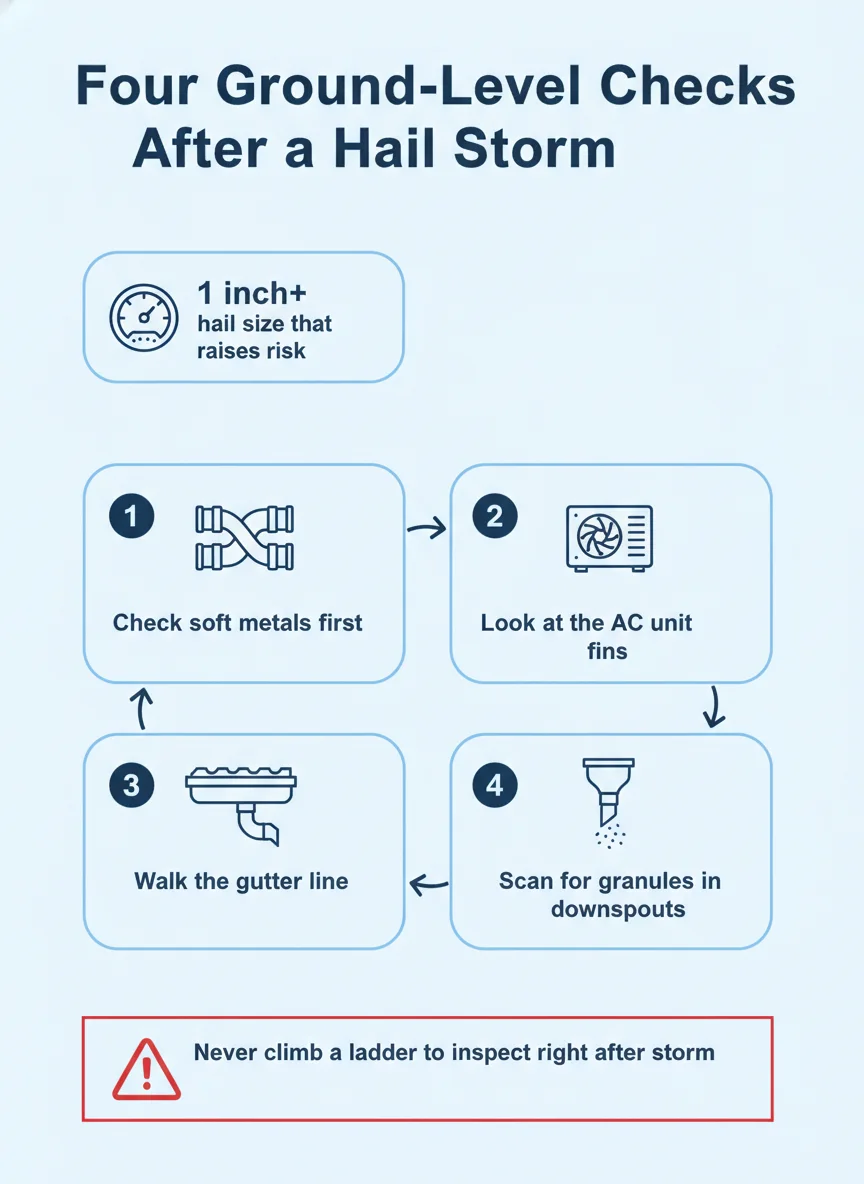
Gutters, downspouts, roof vents, and even the fins on an outdoor AC unit are softer than shingles, so they dent more easily and more visibly. That makes them a useful early warning sign: if you see dings in your gutters or flattened AC fins after a storm, there's a decent chance the roof took a comparable hit, even if you can't see it.
Checking these soft metals is the most reliable ground-level method available to a homeowner, since it doesn't require a ladder and it correlates reasonably well with hail intensity. It's not a substitute for a full inspection, but it's a smart first step before deciding whether to call anyone out.
| Sign | What It Means | Ground Check Possible? |
|---|---|---|
| Dented gutters or downspouts | Hail hit hard enough to deform metal | Yes |
| Bent or flattened AC fins | Comparable impact force hit the roof area | Yes |
| Granules collecting near downspout outlets | Shingles are shedding protective coating | Yes |
| Cracked or bruised shingle mat | Waterproofing layer is compromised | No, needs a closer look |
What's Actually Under Those Granules
Underneath the colored granules on every asphalt shingle is a layer of asphalt coating, and underneath that is the fiberglass or organic mat that gives the shingle its shape and strength. Granules do double duty: they protect the asphalt from UV breakdown and they give the shingle its fire rating. When hail knocks granules loose, both of those protections weaken in that spot.
That's why finding loose granules in your gutters or at the base of a downspout after a storm is worth paying attention to, even if you can't see a crack. It's a direct sign that the protective layer has been disturbed somewhere up top, and granule loss tends to accelerate once it starts.
Step-by-Step: Checking From the Ground
You don't need a ladder to get a useful read on whether a storm did real damage. Walk the perimeter of the house and work through these checks in order.
- Check the gutters: Look for fresh dents or dings along the gutter and downspout, especially on the side of the house that faced the storm.
- Inspect the AC unit: Look at the fins on any outdoor condenser unit; bent or flattened fins are a strong sign of hail impact nearby.
- Look at downspout outlets: Check for a buildup of granules, which look like coarse sand, collecting where water exits the downspout.
- Scan window screens and siding: Dents or tears in screens, siding, or fence caps point to the size and force of the hail that fell.
- Check vehicles if parked outside: Hail dents on a car roof during the same storm are a rough gauge of the hail size that hit your house too.
- Photograph everything: Take dated photos of any dents or granule buildup, which is useful documentation if you end up filing a claim.
- Schedule a closer look: If you find two or more of these signs, it's worth getting a proper inspection rather than guessing from the yard.
What You'll Typically Find Once Someone Gets a Closer Look
Confirmed Damage
When ground-level signs point to a real hit, a closer inspection usually turns up bruised or cracked shingles concentrated on the slope that faced the storm, along with granule loss visible in the gutters. Flashing around vents and chimneys, being softer metal, often shows dents too.
If that's the case, the next step is usually documenting the damage for an insurance claim and getting repairs scheduled before the next round of wind or rain finds the weak spots. Our storm and hail damage team handles that assessment and the documentation together.
No Real Damage Found
Plenty of hailstorms pass through without doing anything beyond cosmetic wear on softer materials. In those cases, an inspection is still worth having on record, both for your own peace of mind and in case a future claim needs a baseline to compare against.
Either way, having a professional look is cheap insurance against the kind of slow leak that shows up a year later with no storm in recent memory to explain it.
DIY vs Calling a Pro
The ground-level checks in this guide are entirely safe and useful for any homeowner to do themselves, and they take less than fifteen minutes to walk through after a storm. Photographing dents and granule buildup is also something you can and should handle on your own, since that documentation matters later.
What you shouldn't do yourself is get on the roof to confirm shingle damage. Bruised shingles are hard to identify even up close without experience, and a wet or storm-battered roof surface is unstable footing. A trained eye can also tell the difference between hail bruising and normal wear, which affects how a claim gets handled.
If your ground check turns up dented gutters, flattened AC fins, or granules in the downspouts, that's the signal to bring in a licensed roofer rather than guessing. An inspection usually takes less than an hour and gives you a clear answer either way.
Keeping an Eye on It Through the Season
Hail season in Oklahoma tends to repeat itself, so it's worth getting in the habit of checking the yard after any storm that drops ice, not just the big ones. Catching damage early, before it turns into a leak, keeps a manageable repair from turning into a bigger job.
If you've had a storm roll through and want a second opinion beyond what you can see from the driveway, All The Way Up Construction can take a closer look and walk you through what's found.
Frequently asked questions
Can you tell if your roof has hail damage without climbing up there?
You can spot some warning signs from the ground, like dented gutters, dinged AC fins, or granules collecting in your downspouts, but you can't fully confirm shingle damage without a closer look. Ground checks tell you whether it's worth scheduling an inspection, not whether repairs are needed.
What size hail causes roof damage?
Hail around an inch in diameter (quarter-size) or larger is generally considered capable of damaging asphalt shingles, though softer metals like gutters and vents can dent from smaller hail too. Wind speed, roof age, and shingle type all affect how much a given hailstorm actually does.
Why does hail damage sometimes not show up right away?
Hail can bruise a shingle's mat without breaking the surface, so the shingle looks fine but has lost its ability to shed water properly. That kind of damage often doesn't turn into a visible leak until months later, which is why a timely inspection matters more than waiting to see a stain on the ceiling.
Do I need to file an insurance claim every time it hails?
Not necessarily. Filing makes the most sense when there's visible damage to soft metals, granule loss, or hail in the quarter-size range or larger, since smaller hail or short storms often leave shingles unaffected.
How soon after a hailstorm should I get my roof checked?
Sooner is better, generally within a few weeks, since exposed or bruised shingles are more vulnerable to further wind and water damage the longer they sit unaddressed. Insurance policies also often have windows for filing a claim, so an early inspection gives you more options.