
Why Attic Airflow Matters More Than Most Homeowners Think
Most people picture roof damage as something that happens from the outside in, caused by sun, wind, or hail. But across the Oklahoma City metro, a lot of early roof failure actually starts from the inside, in the attic, where heat and moisture build up with nowhere to go. A roof deck baking at high temperatures for years loses its structural integrity long before the shingles above it show obvious wear.
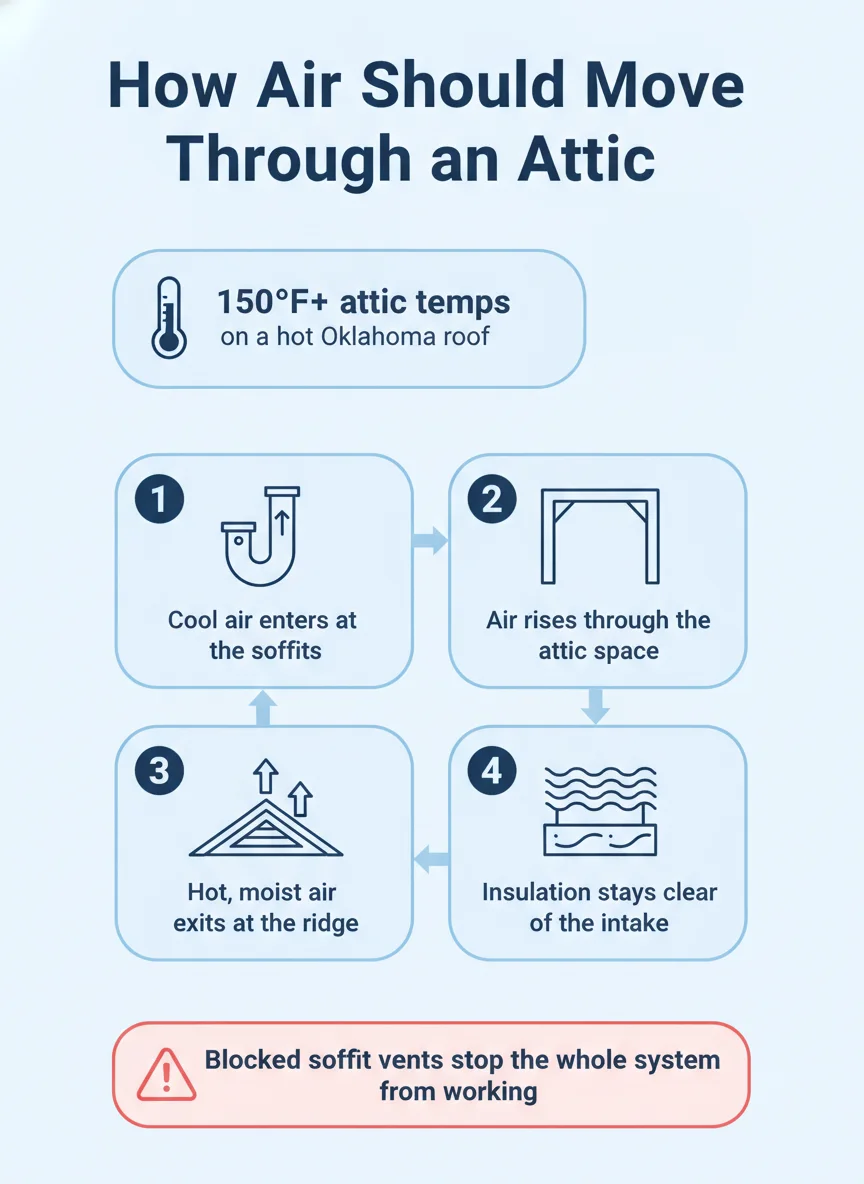
Attic ventilation is the system that's supposed to prevent that. It's a simple idea, cool air enters low and hot air exits high, but when it's blocked or undersized, the attic turns into an oven in summer and a condensation chamber in winter. Either way, the roof system takes the damage long before most homeowners notice anything is wrong from the ground.
How Does Attic Ventilation Actually Work?
Attic ventilation relies on two types of vents working as a pair, intake and exhaust, moving air continuously through the attic space rather than letting it sit stagnant.
Intake Vents: Where Cool Air Gets In
Intake vents are almost always installed in the soffits, the underside of the roof overhang. Cool, dry outside air enters here because it's the lowest point in the attic system, and lower air pressure naturally draws air upward from there. If the soffit vents are painted shut, clogged with debris, or buried under blown-in insulation, the entire ventilation system loses its air supply and nothing downstream can work properly.
Soffit vents are easy to overlook because they're barely visible from the ground, but they're arguably the more important half of the pairing. A ridge vent with no working soffit vents feeding it is like a chimney with the damper closed. It might look installed correctly, but it isn't moving any real volume of air.
Exhaust Vents: Where Hot Air Gets Out
Exhaust vents sit at or near the roof's peak, most commonly as a continuous ridge vent running along the ridge line. As intake air warms inside the attic, it rises and escapes through the exhaust vents, pulling fresh air in behind it and keeping the cycle going. Some older homes use box vents or power attic fans instead of a ridge vent, and those can work, but they have to be sized correctly for the attic's square footage.
Without enough exhaust capacity, heat and moisture simply pool at the top of the attic with no way out. That trapped air presses against the underside of the roof deck for months at a stretch, and the decking, the insulation, and the shingles above it all absorb the consequences.
| Season | What Poor Ventilation Causes | What Good Ventilation Does |
|---|---|---|
| Summer | Attic heat climbs well above outside temps and radiates into the shingles from underneath | Hot air exits continuously, keeping the deck closer to outside temperature |
| Winter | Warm, moist household air condenses on the cold roof deck, leading to frost or rot | Steady airflow carries moisture out before it condenses |
| Year-round | Shingles age faster from heat stress and warranties can be affected by inadequate venting | Shingles perform closer to their rated lifespan |
What a Balanced Ventilation System Is Made Of
A properly balanced system isn't just a ridge vent and a few soffit vents thrown in. It's a calculated ratio of intake to exhaust, sized for the attic's total square footage, and installed so that air has a clear, unobstructed path from the eaves to the peak. Baffles, which are simple channels installed between the rafters at the eave, keep that path open even when insulation is packed in tight.
Gable vents, which sit on the end walls of an attic, were common on older homes but can actually work against a ridge-and-soffit system if both are present, short-circuiting the airflow before it reaches the far end of the attic. On a roof replacement, a good crew evaluates the existing vent setup as part of the project rather than just reusing whatever was there before.
Step-by-Step: How to Check Your Attic's Ventilation
You don't need to climb on the roof to get a basic read on how your attic is venting. Most of this can be checked from inside the attic itself on a warm afternoon or from the ground with binoculars.
- Pick a hot afternoon: Go into the attic on a warm day so you can feel the actual temperature difference, not a mild one where problems are harder to notice.
- Check the soffits: Look up at the underside of the eaves from outside and confirm the vent openings aren't painted over, caked with debris, or covered by a bird or insect nest.
- Look for insulation blocking intake: Inside the attic, check whether insulation has been pushed or blown up against the eaves, covering the point where soffit air should enter.
- Scan the roof deck: Look at the underside of the decking and rafters for dark staining, frost in cold weather, or a musty smell, all signs moisture is sitting instead of moving.
- Note the ridge line: From outside, confirm there's a continuous ridge vent or enough box vents near the peak, rather than vents clustered low or on only one side.
- Write down what you find: Keep a simple note of what's blocked, missing, or damaged so a roofer can address the actual problem rather than guessing.
What Poor Ventilation Looks Like Once It Shows Up
By the time ventilation problems are visible from the outside, they've usually been building for a while. Catching the early signs saves a homeowner from a bigger repair bill down the line.
On the Shingles
Shingles directly above an overheated attic tend to curl, crack, or lose granules faster than the rest of the roof, since that section is absorbing heat stress from both sides. If one slope of the roof looks noticeably more worn than another slope of similar age and sun exposure, uneven attic airflow is a common culprit worth checking for.
This kind of wear is easy to mistake for ordinary aging, which is part of why it goes unaddressed. A roofer checking for storm and hail damage or general wear will usually note whether shingle deterioration looks even across the roof or concentrated in a way that points back to the attic.
On the Deck and Insulation
Inside the attic, look for dark staining on the plywood or OSB decking, especially near the ridge where warm air collects. In winter, frost forming on exposed nail tips is a classic sign of trapped moisture, since those nails are the coldest points in the attic and the first place condensation collects.
Wet or compressed insulation is another red flag. Insulation that's supposed to be fluffy and even sometimes looks matted or discolored in spots where moisture has been settling, and that loss of loft means it's also doing a worse job insulating the living space below.
What a Homeowner Can Check vs. When to Call a Roofer
Clearing debris or an old bird's nest away from a soffit vent, or pulling insulation back from the eaves by hand, is well within reach for most homeowners with attic access. These small fixes can restore airflow without any work on the roof itself.
Installing or replacing a ridge vent, cutting new exhaust vents into the deck, or adding soffit vents where none exist involves working on the roof structure, and that's where a licensed roofer earns the call. Getting the math wrong on vent sizing or placement can leave a system that looks right but still doesn't move enough air.
If you're already having roof repair done for another issue, it's worth asking the crew to check the attic ventilation at the same time, since they'll already be up there and can often spot blocked soffits or an undersized ridge vent in a few extra minutes.
Keeping the Attic Working for the Roof, Not Against It
Attic ventilation isn't a glamorous part of a roof system, but it's one of the few things that affects how long every other part of that roof lasts. A few blocked soffit vents or a poorly placed ridge vent can quietly shave years off a shingle's life long before the roof shows obvious damage from the street.
A quick attic check, especially before or after a roof replacement in Moore or anywhere else in the metro, is one of the cheapest ways to protect that investment. If something about your attic's airflow doesn't feel right, All The Way Up Construction can take a look and tell you plainly what's going on.
Frequently asked questions
How do I know if my attic has bad ventilation?
The clearest signs are shingles that curl or look unusually worn for their age, frost or moisture on the underside of the roof deck in winter, and cooling bills that run high in summer. A musty smell or visible mold on rafters is also a strong signal that air isn't moving the way it should.
What's the difference between intake and exhaust vents?
Intake vents, usually soffit vents under the eaves, let cool outside air into the attic, while exhaust vents, like a ridge vent at the roof's peak, let hot and humid air escape. Both have to work together, because exhaust vents can't pull air out if there's no intake feeding them fresh air.
Can too much insulation cause ventilation problems?
Yes, if insulation is stuffed into the eaves it can block the soffit vents and cut off the attic's air supply. A baffle, which is a small channel installed between the rafters, keeps a clear path for air even when insulation is packed right up to the edge.
Does poor attic ventilation actually shorten the life of shingles?
It can, because trapped heat bakes the underside of the shingles and accelerates the wear that UV exposure is already causing from above. Over years, that extra heat stress shows up as premature curling, granule loss, and a shorter usable life than the shingle was built for.
Is attic ventilation something a homeowner can fix themselves?
Clearing insulation away from soffit vents and adding attic baffles is a reasonable DIY project for most homeowners. Cutting in a ridge vent or adding exhaust vents involves working on the roof deck itself, and that part is usually best left to a licensed roofer.