
Why Impact Ratings Matter in the Oklahoma City Metro
Oklahoma sits in a part of the country where severe thunderstorms and hail are a normal part of the weather pattern, not a rare event. That's why homeowners across the metro, from Moore to Norman to Edmond, ask about impact-resistant shingles more than homeowners in milder climates. The question usually comes up after a storm, during a new build, or when it's time for a roof replacement and the homeowner wants to make a smarter long-term choice.
The term you'll hear most is "Class 4," which refers to a specific independent lab rating, not a marketing phrase. Understanding what that rating actually measures, and what it doesn't, helps you make a clear-eyed decision instead of paying for a label without knowing what it buys you. This guide walks through the test itself, what's inside the shingle, and how to check what's already on your roof.
What Does the Class 4 Rating Actually Test?
The rating comes from a standardized lab procedure called UL 2218, which drops a steel ball onto a shingle sample from a set height and checks whether the shingle cracks, splits, or tears. Shingles are graded Class 1 through Class 4 based on how large a steel ball they withstand without failing. Class 4 is the top tier, meaning the shingle held up under the largest ball size in the test.
The UL 2218 Steel-Ball Test
In the test, a steel ball of a specified weight and diameter is dropped onto a shingle sample from a measured height, simulating the kinetic energy of a hailstone. A Class 4 result means the sample resisted cracking under the largest steel ball used in the standard, roughly comparable in energy to a sizable hailstone impact. It's a repeatable, controlled lab measurement, which is why insurers and manufacturers reference it consistently.
The test is run on new material in a lab, not on an aged roof exposed to years of Oklahoma sun and freeze-thaw cycles. That distinction matters because a shingle's real-world performance can shift over its service life as the asphalt ages, even if its original rating stays the same on paper. The rating tells you how the product performed when new, not a lifetime guarantee.
What Class 4 Does Not Promise
A Class 4 rating does not mean a roof will come through every storm without any marks. Hail can still cause granule loss, surface bruising, or cosmetic damage even on a top-rated shingle, especially from large stones or a direct, repeated impact. The rating is about structural cracking resistance, not about preventing every visible sign of a storm.
It also doesn't account for other storm damage mechanisms like high winds lifting shingle edges or debris impact from falling limbs. A Class 4 roof is still a roof, with flashing, fasteners, and underlayment that each play their own role. Treating the shingle rating as a complete storm-proofing plan skips over the rest of the system that keeps water out.
| Rating Class | Relative Test Severity | What It Generally Signals |
|---|---|---|
| Class 1 | Lowest steel-ball size tested | Entry-level impact resistance |
| Class 2 | Mid-low steel-ball size | Moderate impact resistance |
| Class 3 | Mid-high steel-ball size | Above-average impact resistance |
| Class 4 | Largest steel-ball size tested | Highest impact resistance tier in the UL 2218 standard |
What's Different Inside a Class 4 Shingle
To earn a Class 4 rating, manufacturers typically reinforce the shingle's internal structure, often using a modified asphalt formulation or a reinforced mat layer that flexes under impact instead of cracking. Standard architectural shingles, the kind found on most homes, are built for weathering, wind resistance, and appearance rather than maximum impact absorption. The reinforcement that earns the Class 4 label adds material and manufacturing steps, which is part of why these products sit at a higher price point.
Impact-resistant shingles come in a range of styles now, including architectural profiles that look similar to standard shingles rather than a distinct, obviously different product. That means a homeowner can often upgrade the impact rating without changing the overall look of the house. If you're weighing options for an upcoming project, it's worth asking a contractor directly which product lines in their lineup carry a Class 4 rating, since not every shingle a company installs will.
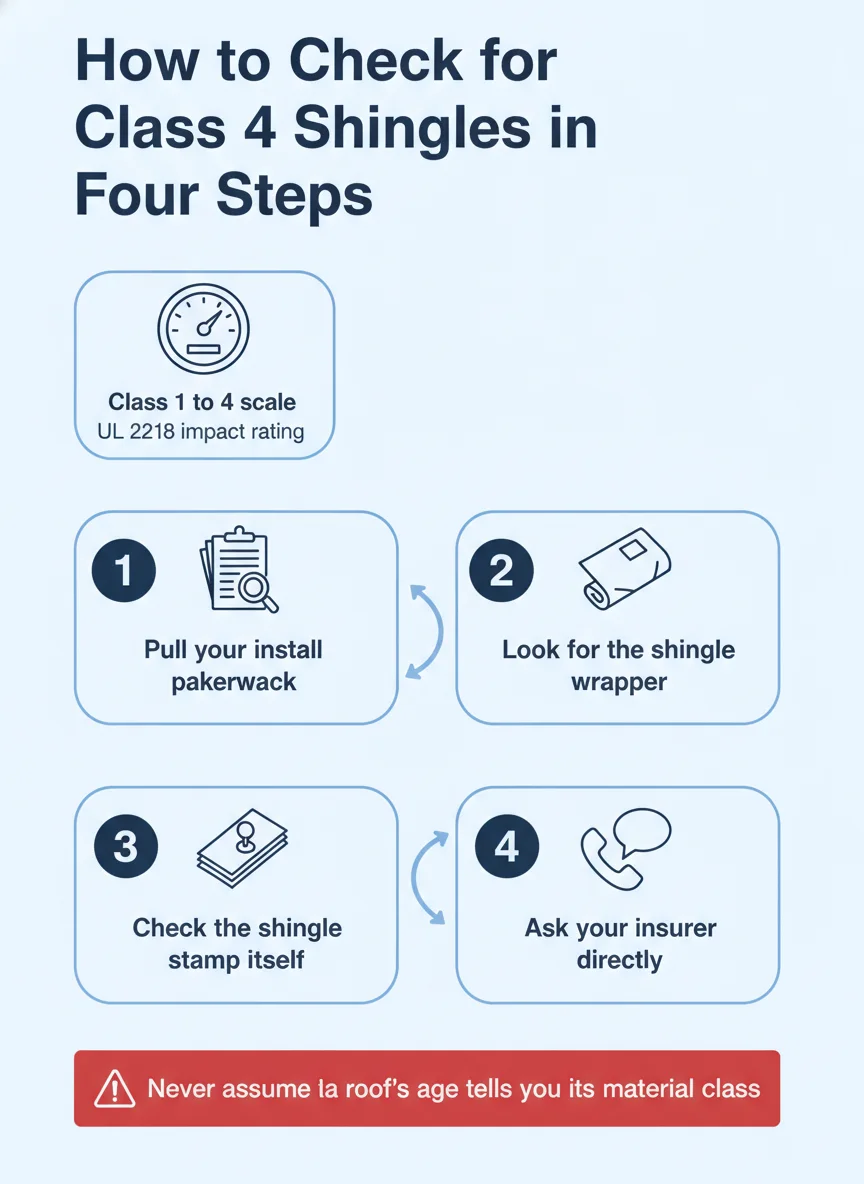
Step-by-step: How to Check If Your Roof Already Has Impact-Resistant Shingles
Most homeowners don't know what material is currently on their roof beyond the color, and that's normal since it's not something you think about until a storm hits or you're planning a sale. Here's the order to check in.
- Pull your paperwork: Dig up the original install invoice or contract, since the shingle manufacturer and product line are almost always listed by name.
- Check leftover wrapper bundles: If any shingle bundles were left in the garage or attic after the job, the wrapper usually prints the product name and its UL 2218 class.
- Look at the shingle stamp: Many shingles print a small manufacturer stamp or code on the back that a roofer can read during a close-up inspection.
- Ask a contractor to identify it: During a roof repair call or routine check, a roofer can often recognize the shingle profile and granule pattern on sight.
- Call your insurance agent: Your insurer may already have the material class on file from a prior claim or underwriting inspection, so it's worth a direct call to ask.
- Compare to manufacturer spec sheets: Once you know the product name, the manufacturer's published spec sheet will state its UL 2218 classification plainly.
What You'll Typically Find When You Check
On an Older Home
Homes built or re-roofed more than a decade or two ago are more likely to have standard three-tab or early architectural shingles without an impact rating, simply because Class 4 products weren't as widely marketed or requested at the time. That's not a defect, it's just a sign of what was standard when the roof went on. The year a home was built doesn't tell you the age of the roof itself, since many homes have been reroofed one or more times since original construction.
If your paperwork is missing and the shingles show heavy wear, granule loss, or curling edges, that's more a sign of the roof's age and condition than any clue about its impact class. A visual check from the ground can tell you a lot about wear, but it won't tell you the UL rating, that requires paperwork or a closer look.
On a Recently Replaced Roof
Homes re-roofed in the last several years are more likely to have an architectural shingle with a documented class rating, since manufacturers have expanded their impact-resistant lines and more homeowners ask about it directly. If your home falls in this group, your invoice is the fastest way to confirm, and it's worth keeping that paperwork somewhere you can find it again.
If you're planning a roof replacement soon and want to weigh impact-resistant options against standard architectural shingles, a straightforward conversation with your contractor about the available product lines, warranty terms, and what each is rated for will get you a clearer answer than trying to guess from online photos.
DIY vs Calling a Pro
Checking your own paperwork, looking for leftover shingle wrappers in the garage, and calling your insurance agent are all things a homeowner can do without any roofing experience. These steps cost nothing but a little time and often answer the question outright, especially if the roof was installed recently and the invoice is still around.
Where it makes sense to call a professional is when the paperwork is missing, the home has changed hands a few times, or you want someone to physically identify the shingle from a close-up look at the roof surface. Reading a manufacturer's stamp or recognizing a granule pattern takes some familiarity with different shingle lines, which is where a working roofer's eye is genuinely useful.
Deciding whether to upgrade to Class 4 shingles on a future project is also worth a direct conversation rather than a guess. A contractor can lay out which product lines they carry, how those lines compare in impact rating and price, and how that fits your specific home and budget, which is a more useful conversation than researching ratings alone.
Is the Upgrade Worth It for Your Home?
Whether a Class 4 shingle is worth the added cost depends on your priorities, how long you plan to stay in the home, and what your insurer offers for impact-resistant materials on your specific policy. For homeowners planning to stay long-term in an area that sees regular severe weather, the added resistance to cracking can be a reasonable trade for the higher upfront material cost.
The best next step is a direct conversation about your specific roof, your budget, and what's actually available rather than relying on general advice alone. All The Way Up Construction walks Oklahoma homeowners through material options plainly so you can weigh a Class 4 upgrade against a standard architectural shingle with real numbers in front of you, not guesswork.
Frequently asked questions
What does Class 4 shingle rated mean?
It means the shingle passed the UL 2218 steel-ball impact test at the highest tier, showing it resists cracking or splitting better than lower-rated products in a controlled lab drop test. It's a rating on the shingle's resistance to impact, not a guarantee against all damage.
Are Class 4 shingles hail-proof?
No, Class 4 shingles are not hail-proof, they're hail-resistant. The rating measures whether a shingle cracks or tears under a standardized impact, but granule loss, bruising, and cosmetic wear can still happen in a real storm.
Do Class 4 shingles lower my insurance premium?
Some insurers offer a discount for impact-resistant roofing materials, but policies and terms vary widely by carrier. The only way to know for certain is to ask your own insurance agent what your specific policy offers.
How can I tell if my current roof already has Class 4 shingles?
Check your original install paperwork or invoice first, since the shingle brand and model are usually listed there. If you don't have the paperwork, a roofer can often identify the product from the shingle's shape and granule pattern during a repair or [roof repair](/services/roof-repair) visit.
Do Class 4 shingles cost more than standard architectural shingles?
Generally yes, impact-resistant shingles tend to sit higher on the price scale than standard architectural shingles because of the reinforced mat and modified asphalt used to pass the test. The exact difference depends on the manufacturer and the specific product line.