
Why the shingle brand name on your estimate actually matters
When a homeowner in the Oklahoma City metro gets a few estimates for a roof replacement, the shingle brand listed on each one often looks like a minor line item next to the total. It isn't. The brand and product line determine the wind rating your roof carries, how long algae resistance lasts before streaking sets back in, and what the manufacturer will and won't cover if a shingle fails early.
Oklahoma sees enough wind, hail, and sun exposure in a given year that these specs aren't just marketing copy, they're the numbers that decide whether a shingle holds up through a rough spring. Understanding what CertainTeed, Owens Corning, and GAF actually differ on helps you read any estimate with a sharper eye, whether you're comparing quotes in Moore, Norman, or anywhere else in the metro.
What separates one shingle brand from another
At the architectural shingle tier, the three major national brands are closer than their marketing suggests. All of them laminate two layers of asphalt-coated fiberglass into a dimensional shingle, all of them offer a Class 4 impact-resistant option, and all of them carry algae-resistant granule technology. The real differences show up in how each brand structures its warranty, how long the algae warranty runs, and which product tiers are available in a given market.
Product line structure
Most brands sell in three tiers: a basic three-tab, a mid-range laminated architectural line, and a premium designer line meant to mimic slate or shake. CertainTeed's Landmark, Owens Corning's Duration, and GAF's Timberline HDZ all sit in that mid-range architectural tier, which is where most Oklahoma re-roofs land because it balances wind performance, impact rating, and curb appeal.
Above that tier, each brand has a designer line with a heavier shingle and a more dimensional profile, and below it sits a basic three-tab that's lighter, flatter, and carries a shorter warranty. Knowing which tier a quote references matters more than the brand name itself, since a basic line from one manufacturer and a premium line from another aren't really comparable products.
Warranty structure
Manufacturer warranties typically split into a materials-defect warranty, a wind warranty, and a separate algae-resistance warranty, and the fine print on each varies by brand and by product tier. A limited lifetime warranty on materials usually prorates after the first several years, meaning the payout for a defect drops the longer the shingle has been on the roof.
None of these manufacturer warranties cover installation mistakes, which is a separate category entirely. That's what a workmanship warranty from your roofing contractor is for, and it's worth confirming in writing before work starts rather than assuming it's bundled into the shingle warranty.
| Shingle tier | Typical wind rating | Algae resistance warranty |
|---|---|---|
| Three-tab (basic) | 60-70 mph | Shorter coverage window, varies by brand |
| Architectural (mid-range, e.g. Landmark, Duration, Timberline HDZ) | 110-130 mph when installed per spec | Extended algae-resistance coverage, separate from materials warranty |
| Designer (premium) | 110-130 mph when installed per spec | Extended algae-resistance coverage, often matched to the architectural tier |
What's actually inside a laminated architectural shingle
A laminated shingle is built from two asphalt-saturated fiberglass mats pressed together, with the top layer cut into a staggered, dimensional pattern and the bottom layer left solid. That lamination is what gives architectural shingles their thicker, more textured look compared to a flat three-tab, and it's also what adds the extra weight that helps with wind performance.
Ceramic-coated granules are embedded into the top surface to handle UV exposure, and in algae-resistant lines, a portion of those granules are infused with copper or zinc compounds that slow the growth of the algae responsible for black streaking. The self-sealing adhesive strip on the underside is what bonds each course to the one below it once the sun warms the roof after install, which is part of why wind ratings assume a proper, timely installation.
Step-by-step: how to compare shingle brands before you decide
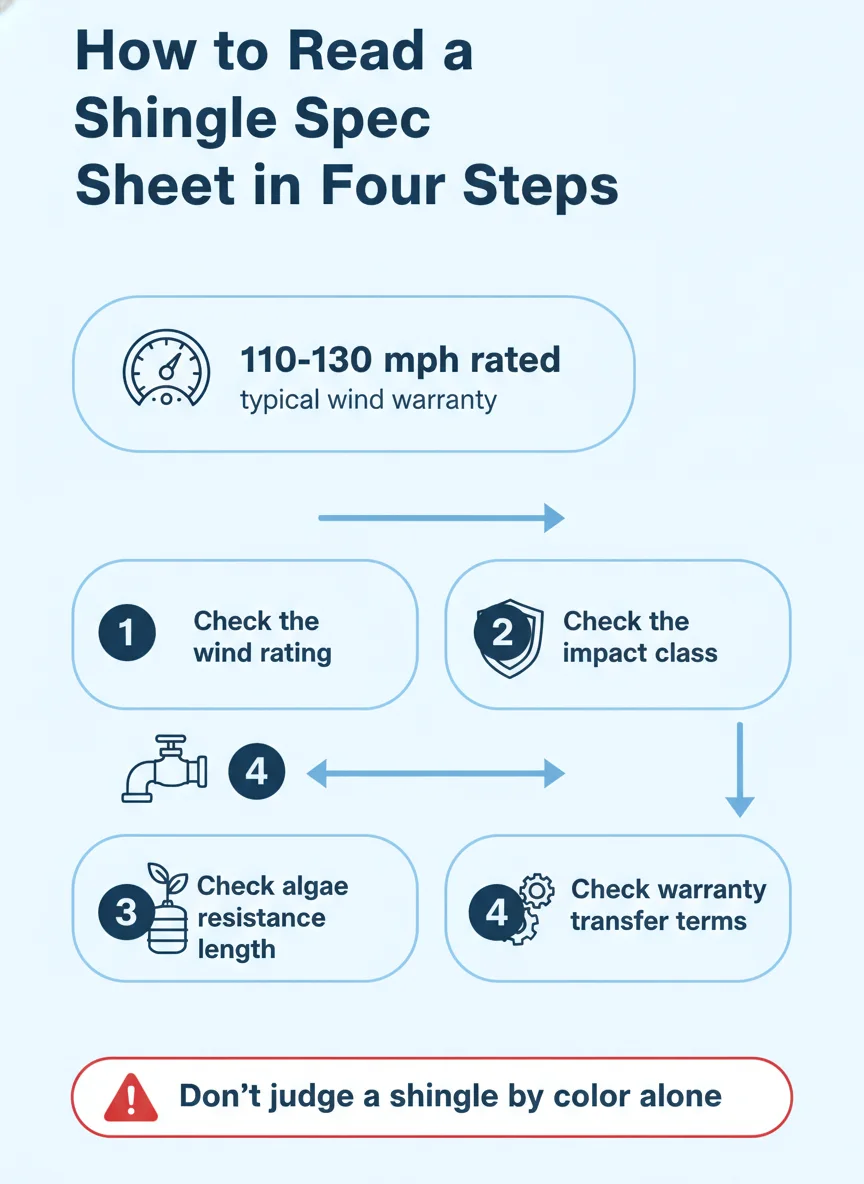
If you're weighing quotes that list different shingle brands, work through the spec sheet in this order rather than going by name recognition or color alone.
- Confirm the product tier: Make sure you're comparing architectural to architectural, not a basic three-tab quote against a premium designer quote.
- Check the wind rating: Look for the mph rating and confirm it's tied to the manufacturer's required nailing pattern, since an improper install can void that rating.
- Check impact class: A Class 4 impact rating means the shingle passed a steel-ball drop test for resistance to hail damage, which some Oklahoma homeowners prioritize.
- Check algae warranty length: Ask how many years the algae-resistance coverage runs separately from the general materials warranty.
- Check warranty transferability: Find out whether the manufacturer warranty transfers to a new owner if you sell the home, and under what conditions.
- Ask about workmanship coverage: Get your roofer's workmanship warranty in writing, since it's the only coverage that protects against installation error.
- Compare availability: Confirm the exact color and line is currently stocked for your region rather than special-order, which can affect your timeline.
What the differences actually look like once a roof is finished
On the roof itself, most homeowners can't tell CertainTeed Landmark, Owens Corning Duration, and GAF Timberline HDZ apart from the street. All three use a similar dimensional cut and a comparable color palette, and all three weather at roughly the same pace under Oklahoma sun and wind. The visible differences tend to be subtle: slightly different shadow lines, slightly different granule blend, and brand-specific color names for what are often very similar shades.
Where brand choice does matter
Brand choice matters more when something goes wrong years down the line. If a batch of shingles has a manufacturing defect, the claims process, documentation requirements, and payout structure differ by manufacturer, and some brands are more straightforward to work with than others. A roofer who regularly installs a given line usually has a better sense of how that claims process actually runs in practice.
Where brand choice matters less
Day-to-day performance against Oklahoma's wind, UV, and the occasional hail event is where brand matters least, since all three major manufacturers test their architectural lines to similar wind and impact standards. The quality of the roof replacement installation itself, proper nailing, correct underlayment, and clean flashing work around penetrations, has a bigger effect on how the roof performs than which of the three names is on the wrapper.
What homeowners can check themselves, and what needs a roofer's eye
A homeowner can absolutely read spec sheets, compare wind ratings, and ask pointed questions about warranty terms before signing anything, and doing that homework is one of the best ways to make sure quotes are actually comparable. You can also look up a manufacturer's certified installer list to see whether a contractor carries any brand-specific certification that extends warranty coverage.
What's harder to self-assess is whether a given shingle line is the right fit for your roof's pitch, ventilation setup, and sun exposure, since those factors affect how a shingle ages even within the same product line. That's a judgment call that benefits from someone who's installed the line on roofs similar to yours and seen how it holds up over time.
It's also worth asking any roofer whether they're reporting a shingle's rated performance or their own experience with it, since the two aren't the same thing. A straightforward answer about both is usually a good sign you're talking to someone who knows the material, not just reciting the brochure.
Picking a shingle that fits your roof, not just the brand name
The honest takeaway is that CertainTeed, Owens Corning, and GAF all make a dependable architectural shingle, and the gap between their mid-range lines is narrower than the marketing suggests. The decision usually comes down to warranty structure, availability of the color you want, and how comfortable your roofer is installing that particular line to spec.
All The Way Up Construction installs CertainTeed Landmark, Owens Corning Duration, and GAF Timberline HDZ across the Oklahoma City metro and can walk through the spec sheet differences on any of them before you decide.
Frequently asked questions
Is one shingle brand actually better than the others?
No single brand dominates across every category. CertainTeed, Owens Corning, and GAF all produce laminated architectural shingles that meet similar wind and impact standards, and the differences tend to show up in warranty structure and algae-resistance length rather than core durability.
What does a shingle's wind rating actually mean?
A wind rating tells you the sustained wind speed the shingle was tested to withstand when installed according to the manufacturer's nailing pattern. It's a lab number, so real-world performance also depends on how well the shingle was actually installed and fastened on your roof.
Do algae-resistant shingles really stop black streaks?
Algae-resistant shingles contain copper or zinc granules that discourage algae growth, and most brands back this with a dedicated warranty period separate from the general materials warranty. They slow staining significantly but don't make a roof permanently immune to it, especially in humid climates.
Does a longer manufacturer warranty mean a better shingle?
Not automatically. Manufacturer warranty length often reflects the product tier (three-tab versus architectural versus designer) more than a meaningful quality gap, and it only covers material defects, not installation errors, which is why a separate workmanship warranty from your roofer matters too.
Can I mix shingle brands on one roof?
It's technically possible but not recommended, since color match, granule texture, and warranty coverage can all vary between manufacturers. Most roofers keep a single brand and product line across an entire roof so the warranty stays intact and the finished look is uniform.