
Why This Question Matters for Oklahoma Homeowners
Every roof in the Oklahoma City metro deals with the same stretch of weather: hot, UV-heavy summers, hard freezes in winter, and wind that doesn't let up much in between. That cycle wears a roof down gradually, and most homeowners don't think about it until a leak shows up or a contractor points out something during a repair visit. The question of whether to fix the problem in front of you or start planning for a full replacement comes up more than people expect.
The honest answer is that it depends on the pattern, not the single issue sitting in front of you right now. A missing shingle after a windstorm is usually a simple fix. A roof that's needed three separate repairs in the last two years is telling you something different. Knowing the difference between an isolated problem and a roof reaching the end of its service life can save a homeowner from spending money on repairs that were never going to hold.
What Actually Wears a Roof Down Over Time
Shingles are built to shed water and block UV light, but both jobs slowly use up the material underneath them. Granules wear off, the asphalt underneath dries out and gets brittle, and seals that once held tight start to loosen. None of this happens overnight, and none of it is visible from the ground most of the time, which is why a roof can look fine from the driveway while it's actually close to done.
Sun and Heat
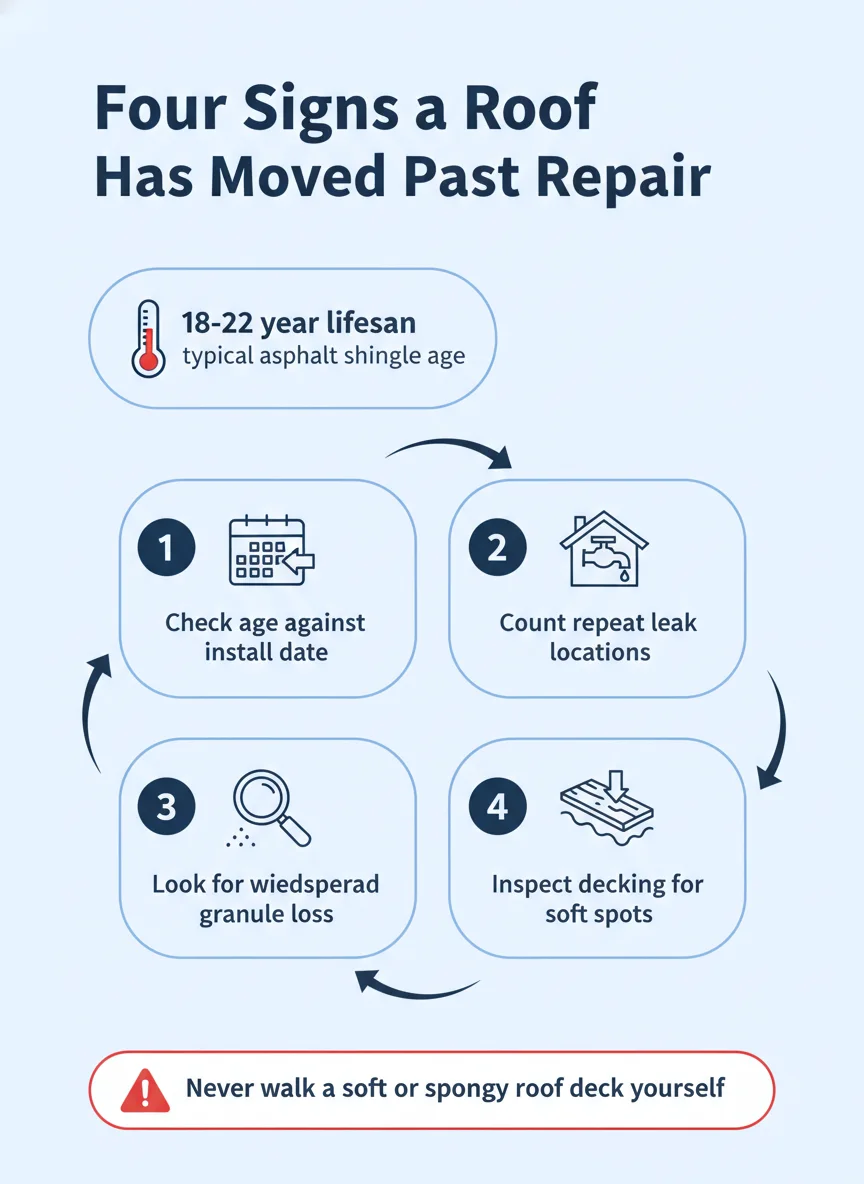
Oklahoma summers put a lot of direct UV exposure on a roof, and heat accelerates the aging process of asphalt shingles across the whole industry, not just here. Over years, that exposure dries out the oils in the shingle and makes it more brittle, which is part of why asphalt shingles in this climate typically run an 18 to 22 year service life rather than lasting indefinitely.
Freeze and Thaw Cycles
Winter brings the opposite stress. Any moisture that's worked its way under a shingle or into a crack can freeze, expand, and widen that opening, then thaw and let more water in next time. Repeating that cycle every winter for years is one of the main reasons flashing and seals fail in multiple spots at once rather than just one.
| Situation | Usually a Repair | Usually Points to Replacement |
|---|---|---|
| Age of the roofing | Under 10-12 years old | Approaching or past 18-22 years |
| Leak history | First leak, single location | Repeat leaks in different spots |
| Shingle condition | A few missing or cracked shingles | Widespread granule loss, curling across the roof |
| Decking | Solid, no soft spots found | Soft or spongy decking in multiple areas |
The Parts of a Roof Most Likely to Fail First
Flashing, the metal strips sealing joints around chimneys, skylights, and vent pipes, tends to fail before the shingle field does. It's thinner material doing a harder job, sealing a seam rather than just shedding water across a flat plane, so it's often the first thing a roofer checks when a leak shows up. A skylights and flashing visit early on can catch a failed seal before it turns into a decking problem.
Decking is the layer underneath the shingles, and it's the part that tells the real story. Shingles can look rough on the surface while the decking underneath is still solid, or shingles can look okay while the decking has already gone soft from a slow leak nobody noticed. A roofer checking for soft spots by walking the roof carefully is looking past the surface at what's actually holding things up.
Step-by-Step: How a Roofer Checks Whether a Roof Is Past Repair
A thorough evaluation doesn't start and end with a glance from the ground. Here's generally how it goes when a roofer is trying to figure out whether a problem is isolated or whether it's part of a bigger pattern.
- Pull install records: We start by figuring out the actual age of the roofing, not the age of the house, since the two are rarely the same.
- Walk the full roof: We check every slope, not just the area near the reported leak, since problems in one section often show up elsewhere too.
- Check granule wear: Heavy, even granule loss across the shingle field is a sign of age-related wear rather than one localized issue.
- Inspect every flashing point: Chimneys, skylights, and vent boots get checked individually since a failed seal in one spot often means the others are close behind.
- Look for soft decking: We check for give underfoot in multiple spots, which signals moisture has already reached the wood underneath the shingles.
- Review repair history: If the home has had multiple repairs recently, we look at whether those repairs addressed the same root cause or just patched symptoms.
- Give an honest recommendation: We lay out what a repair would and wouldn't fix so the homeowner can decide with the full picture in front of them.
What the Findings Usually Mean
When the problem is contained, isolated flashing failure, one cracked section, storm damage to a specific area, a repair is usually the right call and the rest of the roof keeps doing its job. These are the cases our Roof Repair team handles most often, and most get fixed in a single visit.
When the Pattern Points to Age
Granule loss spread evenly across every slope, shingles curling or cupping in multiple spots, and a roof sitting near or past that 18 to 22 year mark all point the same direction. At that stage, a repair might buy a season, but the material underneath is wearing out everywhere at roughly the same pace, so new problems tend to show up faster than they can be patched.
When the Pattern Points to a Bigger Structural Issue
Soft decking found in more than one area, a prior layover that's trapping moisture, or repeat leaks that keep reappearing after being patched usually mean water has been getting in for a while. In cases like this, a roofer isn't just fixing the surface anymore, they're dealing with what's underneath it, and that's typically where Roof Replacement starts to make more financial sense than another round of patches.
What a Homeowner Can Check vs. What Needs a Roofer
From the ground, a homeowner can look for obvious warning signs: shingle granules collecting in gutters or at downspouts, daylight visible through the attic roof boards, water stains spreading on ceilings, or shingles that look curled or cracked from a distance with binoculars. These are useful early clues and worth checking every season, especially before storm season in Oklahoma.
What a homeowner generally shouldn't do is get on the roof to check decking firmness, pull back shingles to inspect underlayment, or try to assess flashing seals up close. That work requires both the right footing equipment and the experience to know what normal wear looks like versus a failure point, which is why this part of the evaluation needs a licensed roofer rather than a weekend project.
The split comes down to risk and judgment. Ground-level checks are safe and give you a heads-up that something might be going on. Anything that involves climbing onto the roof itself, especially an older one with unknown decking condition, is where the liability and the actual diagnosis both belong to a professional, not a homeowner with a ladder.
Getting a Straight Answer Before You Spend Money
The worst outcome isn't choosing repair or replacement, it's guessing wrong and finding out later. A homeowner who patches a roof that's actually failing structurally ends up paying for that patch and the replacement a year later. A homeowner who replaces a roof that only needed a flashing repair spends far more than the problem required. Getting an honest look at the actual condition, not just the symptom that prompted the call, is what prevents both mistakes.
If you're seeing repeat leaks, visible wear across multiple slopes, or a roof that's getting up there in age, it's worth getting a straight read on where it actually stands before deciding what to do next. All The Way Up Construction walks homeowners across Moore and the rest of the metro through exactly that, so the next move is based on what's really going on up there, not a guess.
Frequently asked questions
How do I know if my roof needs to be replaced instead of repaired?
The clearest sign is a pattern, not a single problem. If you've paid for three or more repairs in a couple years, if leaks keep showing up in new spots, or if the shingles are nearing the end of their expected lifespan, replacement usually costs less over time than continuing to patch.
Can a roof be repaired if it has soft spots in the decking?
A small, isolated soft spot can sometimes be cut out and replaced during a repair, but widespread soft decking usually means moisture has been getting in for a long time. At that point the underlying structure, not just the surface, needs attention, which generally points toward replacement.
Does the age of my house tell me the age of the roof?
No, and this trips up a lot of homeowners. The year a house was built is not the same as the age of the roof, since roofs get replaced on their own schedule separate from the home itself. Check closing paperwork, permits, or ask a roofer to estimate wear if you're not sure.
Is one more repair ever the right call on an older roof?
Sometimes, yes, especially if the damage is isolated and the rest of the roofing is in solid shape. A roofer can tell you honestly whether a repair will hold or whether you're about to spend money patching something that's going to fail again soon anyway.
What happens if I keep repairing a roof that's actually past that point?
You end up paying for the same problem more than once, and the delay often lets water reach the decking, insulation, or interior of the home, which turns a roofing cost into a bigger repair bill. Catching the pattern early saves money even when replacement feels like the bigger expense up front.