
Why Metal Is Showing Up More on Oklahoma City Metro Roofs
Metal roofing used to be something you saw mostly on barns and commercial buildings around the Oklahoma City metro. That's changed. More homeowners in Moore, Norman, and towns throughout the region are asking about standing seam and screw-down panels when it's time to replace an aging roof, usually because they've heard about the lifespan or they like the clean, modern look.
Part of the shift is weather. Central Oklahoma sees everything from summer heat to high wind to hail in the same calendar year, and a metal roof is built to shrug off a lot of that. It's not the right fit for every home or every budget, but it's worth understanding how it actually works before you rule it in or out.
How a Metal Roof Is Actually Built
A residential metal roof is not one product, it's a system: solid decking, underlayment, panels, and a set of flashing and trim pieces that tie everything together at the edges, valleys, and penetrations. The panel style is the biggest decision point, and it determines how the roof looks, how it's fastened, and how it ages over the decades ahead.
Standing Seam
Standing seam panels have a raised, interlocking seam that runs vertically up the roof, and the fasteners are hidden underneath that seam rather than exposed on the panel face. That hidden-fastener design is a big part of why standing seam has a longer track record of resisting leaks over time, since there's no exposed screw head for water or UV to work on.
The tradeoff is cost and installation skill. Standing seam takes more specialized equipment and a crew that's done it before, so it tends to sit at the higher end of the metal roofing spectrum. For homeowners planning to stay in a house long-term, that upfront difference is often weighed against decades of lower maintenance.
Screw-Down (Exposed Fastener)
Screw-down panels, sometimes called exposed-fastener panels, are fastened directly through the panel face with gasketed screws. It's a simpler, generally less expensive install than standing seam, and it's a common choice for garages, outbuildings, and homeowners who want the metal look and durability without the standing seam price tag.
The catch is that those exposed fasteners are the roof's weak point over time. The rubber gaskets under each screw head will eventually compress or wear, and a well-maintained screw-down roof usually needs the fasteners checked and occasionally replaced well before the panels themselves wear out.
| Factor | Standing Seam | Screw-Down |
|---|---|---|
| Fasteners | Hidden under the seam | Exposed through the panel face |
| Typical cost | Higher upfront | Lower upfront |
| Maintenance | Minimal for decades | Periodic fastener checks |
| Common use | Primary home roofs | Outbuildings, budget-conscious installs |
What the Panels Are Actually Doing Up There
Underneath the finish color, metal roofing panels are engineered to move. Metal expands and contracts with temperature more than asphalt does, and a good install accounts for that with clip systems or slotted fastener holes that let the panel shift slightly without buckling or tearing loose. This is part of why a proper install matters more with metal than it does with a lot of other roofing types.
The underlayment and decking underneath do the quiet work of waterproofing and sound dampening. A solid deck with a quality underlayment is what keeps a metal roof from sounding like a drum in a rainstorm, so the roof's performance depends as much on what's underneath the metal as the metal itself.
Step-by-step: How a Metal Roof Install Comes Together
The process looks different from a shingle tear-off and reinstall in a few key ways, mostly around precision and sequencing. Here's roughly how it goes.
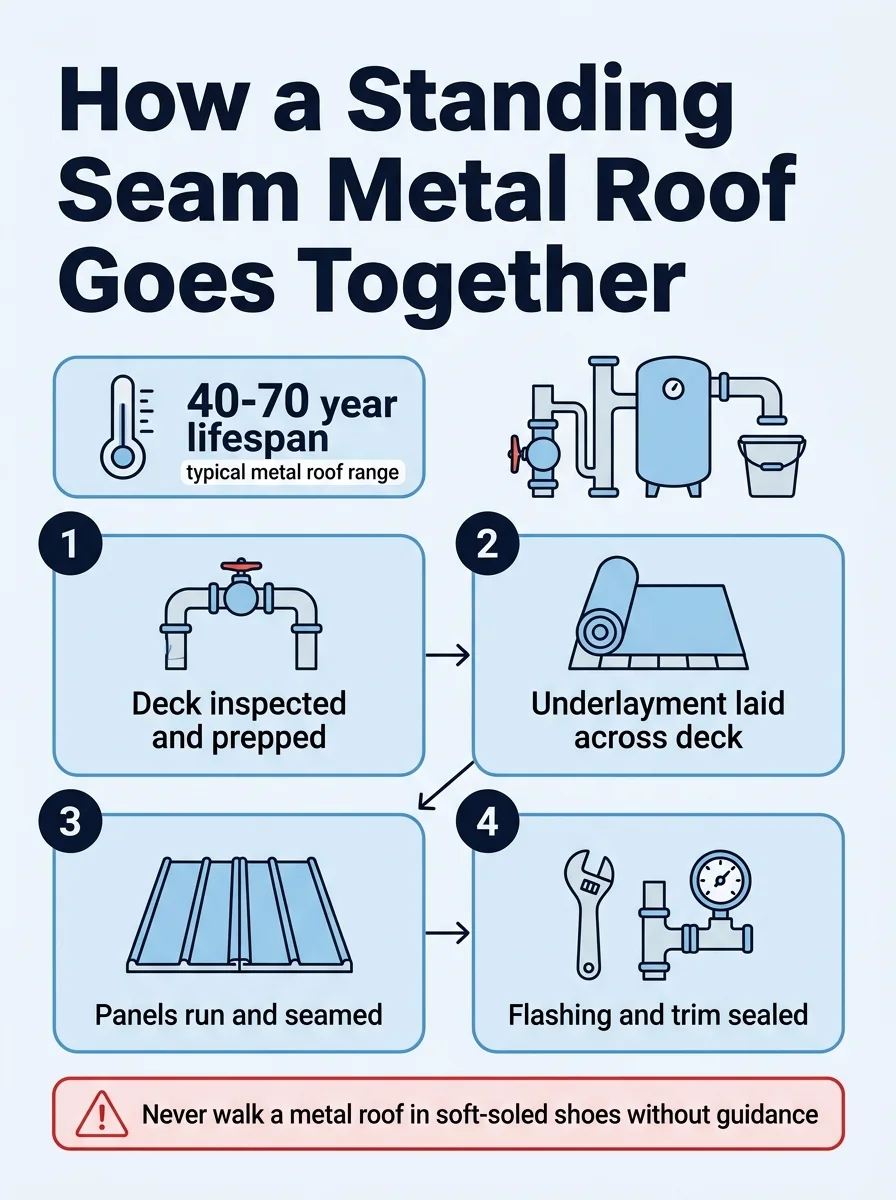
- Deck inspection: The existing deck is checked for rot, soft spots, or damage, since metal needs a solid, flat surface underneath to perform correctly.
- Underlayment install: A synthetic or high-temp underlayment is rolled across the deck to add a water barrier beneath the panels.
- Panel layout: Panels are measured and cut to the roof's dimensions, accounting for expansion gaps and overlap at seams.
- Panel fastening: Standing seam panels are clipped and seamed together; screw-down panels are fastened directly with gasketed screws.
- Flashing and trim: Ridge caps, valleys, and penetrations around vents or skylights get custom-fit flashing to keep water moving off the roof.
- Final walk-through: The completed roof is checked for proper seam closure, fastener tightness, and clean trim lines before the crew leaves.
What Homeowners Notice After a Few Years
Aging and Appearance
A quality metal roof holds its color and finish well, though some fading is normal over a couple decades of Oklahoma sun. Standing seam panels tend to look nearly the same at year fifteen as they did at year one, while exposed-fastener roofs may show slight streaking around the screw heads as gaskets age.
Dents from hail are the question most homeowners ask about. Metal roofing generally resists hail damage better than asphalt in terms of actual leaks, since a dent doesn't break the water seal the way a torn or missing shingle does. Cosmetic denting can still happen in a severe event, and that's a conversation to have with your insurer.
Weight and Structure
Metal panels are lighter per square foot than most shingle products, which is one reason metal is sometimes considered for older homes or additions where the framing wasn't built for heavier roofing. That said, every home is different, and a licensed roofer should evaluate the structure before assuming a metal roof is a drop-in option.
The lighter weight doesn't mean the install is simpler, though. Metal still needs a properly braced deck and correctly spaced fastening or clip pattern to perform the way it's designed to over the decades ahead.
What a Homeowner Can Handle vs What Needs a Licensed Roofer
Visual checks are within reach for most homeowners. Walking the yard after a storm and looking for dented panels, loose trim, or debris in valleys from the ground is reasonable, and so is keeping gutters clear so water moves off the roof the way it's designed to.
Everything involving the panels themselves is a different story. Cutting and fitting standing seam panels requires specialized tools and a crew experienced with metal, and improperly cut or seamed panels can leak in ways that are hard to diagnose later. Roof repair on a metal roof also calls for matching the existing panel profile and finish, which a general handyman typically isn't equipped to do.
Full installs and replacements are squarely a licensed-roofer job. Between the structural check, the underlayment work, and the flashing details, there are too many places a DIY or inexperienced install can go wrong on a roof you're counting on for decades. A full roof replacement with metal is an investment worth protecting with a crew that's done the work before.
Is Metal the Right Call for Your Home
Metal roofing isn't a universal upgrade, it's a tradeoff between a higher upfront cost and a much longer runway before the next replacement. For homeowners planning to stay put for years, that math often works out in metal's favor, especially with the reduced maintenance standing seam offers. For others, a quality shingle roof still does the job well and at a more familiar price point.
If you're weighing metal against shingles for a home anywhere in Moore, Norman, or the rest of the Oklahoma City metro, it helps to start with an honest look at your current roof and your long-term plans for the house. You can also read about three-tab, architectural, and designer shingles if you're still comparing material families before deciding, and All The Way Up Construction can walk through both options for your specific home.
Frequently asked questions
Is a metal roof louder than shingles when it rains?
With solid decking and underlayment underneath, a metal roof is not noticeably louder than asphalt shingles. The noise myth comes from older open-frame metal buildings with no decking, which is a different structure than a residential metal roof over plywood.
Does a metal roof attract lightning?
No, metal roofing does not attract lightning any more than any other roofing material, and a strike is just as likely to hit a tree or a shingle roof in the same spot. Metal is actually non-combustible, which some homeowners see as an upside if lightning does strike nearby.
How much does a metal roof weigh compared to shingles?
Standing seam and screw-down panels are considerably lighter per square foot than asphalt shingles, which is one reason some older homes can accept a metal upgrade without structural changes. A licensed contractor should still confirm your home's framing before any switch.
Can you install metal roofing over existing shingles?
It depends on the local code and the condition of the existing roof deck, so this is a question for a licensed roofer looking at your specific home. In many cases a full tear-off gives the new roof a cleaner, longer-lasting result.
How long does a metal roof last in Oklahoma?
Metal roofing commonly runs in the 40 to 70 year range industry-wide, well beyond the typical lifespan of asphalt shingles. Actual lifespan still depends on the panel type, the install quality, and how the roof is maintained over the years.