
Why wind damage shows up so often in the Oklahoma City metro
Homes across the Oklahoma City metro deal with wind events most of the year, not just during spring storm season. Gusts that come through ahead of a front, or a straight-line blow that rolls across open country before it hits a neighborhood, can be enough to lift shingles that would otherwise sit tight for another decade. It doesn't take a named storm to do it.
That's why so many homeowners in towns like Moore, Norman, and Yukon notice a few shingles in the yard or on the driveway after an otherwise unremarkable windy night. It's easy to treat it as cosmetic, a quick patch and move on. But wind rarely damages just the shingles you can see from the curb, and understanding what's actually happening under the surface changes how you should respond.
What actually happens to a shingle in high wind
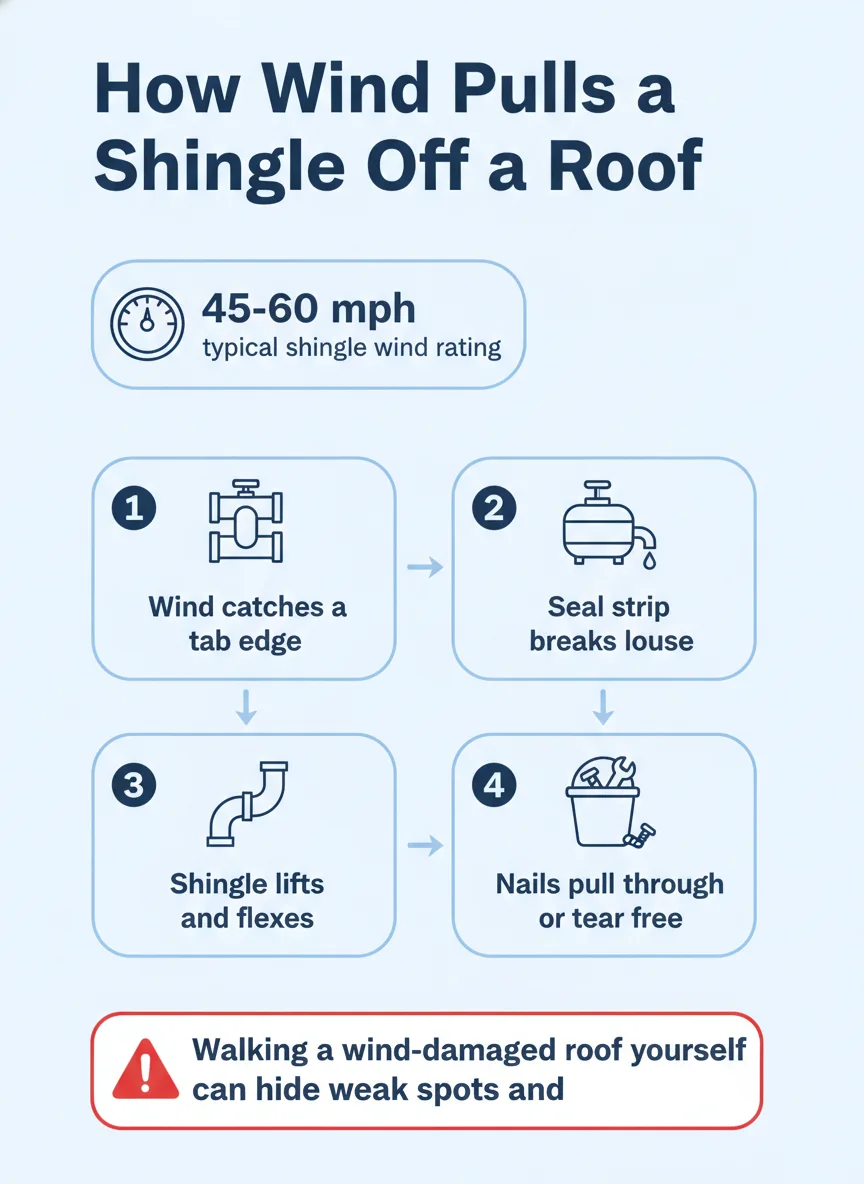
Every shingle is held down two ways: nails driven through the top edge, and a factory-applied seal strip that bonds to the shingle below it once it's been through a season of sun and heat. Wind doesn't need to rip a shingle clean off to cause trouble. It just needs to get under an edge, break that seal, and start flexing the shingle up and down with every gust. That flexing is what eventually tears the shingle loose from the nails, sometimes all at once, sometimes gradually over several storms.
The seal strip is the real weak point
A shingle's seal strip is a strip of adhesive that bonds to the shingle course below it, and it's what keeps wind from getting a grip in the first place. Once that bond breaks, even if the shingle doesn't blow off, it's loose enough to lift with every strong gust afterward. A shingle with a broken seal strip looks completely normal sitting on the roof, which is exactly why a ground-level look doesn't tell the full story.
This matters because the number of shingles you see missing is usually smaller than the number with a broken seal. Wind that was strong enough to tear a dozen shingles off completely was almost certainly strong enough to break the seal on shingles around them that are still sitting in place, just loose.
Why nails pull through or tear free
Underneath the seal issue, there's the nailing itself. Shingles are nailed through a specific zone, and if a nail was driven a little high, or at an angle, it has less holding power against uplift. Over the life of a roof, those marginal nail jobs are usually the first to give way in wind, which is one reason damage often clusters in certain spots rather than spreading evenly.
Ridge caps and the shingles closest to roof edges take the worst of it, since that's where wind generates the most uplift pressure as it passes over the roofline. If you're seeing missing shingles concentrated along a ridge or an edge rather than scattered across the whole roof, that's a pattern a roofer will recognize immediately.
| Situation | What it usually means | Likely path |
|---|---|---|
| A handful of shingles missing, roof under 10 years old | Isolated wind damage with broken seals nearby | Targeted repair |
| Missing shingles scattered across multiple slopes | Wider uplift damage, aging shingles losing adhesion | Repair with close inspection, possible partial replacement |
| Missing shingles plus visible curling or bald spots elsewhere | Shingles near end of life, wind just finished the job | Full replacement likely the better value |
| Missing shingles with soft spots or deck movement underfoot | Deck damage beneath the shingles | Replacement, deck repair included |
What's actually under those missing shingles
Pull back a missing shingle and you'll usually find underlayment, a water-resistant barrier layer that's meant to be a backup, not a permanent cover. It can handle rain for a little while, but it's not built for ongoing exposure, especially at seams and nail holes. Left alone through a few more rain events, water starts finding its way to the wood deck underneath.
The deck itself is usually plywood or OSB sheathing, and it's the structural layer everything else is fastened to. Decking that stays wet repeatedly starts to soften, and soft decking won't hold nails the way it should on the next set of shingles, which is why a repair that only addresses the missing shingles without checking the deck underneath can set up a repeat problem.
Step-by-step: how a roofer evaluates wind damage
A proper wind damage check goes well beyond counting missing shingles from the driveway. Here's the general order most roofers work through.
- Ground-level walk-around: A first pass around the house to note obvious missing or damaged shingles, debris in the yard, and any sagging or visible gaps along the roofline.
- On-roof inspection: Walking each slope to check for loose, lifted, or cracked shingles that aren't visible from the ground, plus any exposed nail heads.
- Seal strip check: Testing shingles near the missing ones by hand to see which have broken their bond but haven't blown off yet.
- Deck inspection: Checking exposed decking for soft spots, staining, or movement underfoot anywhere shingles are gone.
- Flashing and penetration review: Looking at vents, skylights, and chimneys nearby since wind-lifted shingles often loosen flashing at the same time.
- Documentation: Photos of every affected area, useful both for your own records and for an insurance claim if you decide to file one.
- Written recommendation: A clear explanation of what's repairable, what's compromised, and why, so you can make the call with full information.
How do you tell if it's time to replace instead of repair?
It comes down to age and extent. A roof that's relatively young with isolated wind damage is almost always a repair candidate, since the surrounding shingles still have plenty of life and adhesion left in them. The math changes once the shingles are already showing wear on top of the wind damage, curling edges, granule loss, brittle tabs, because at that point the wind just exposed a problem that was coming anyway.
When a repair makes sense
Repair is the right call when the damage is contained to a section, the shingles elsewhere are flexible and holding their seal, and the deck underneath checks out dry and solid. Matching shingles gets easier the newer the roof is, since there's less sun fading to account for, which is another point in favor of repairing sooner rather than letting a small issue sit.
When replacement is the better value
Replacement starts making more sense once wind damage shows up on a roof that was already past its prime, or when the missing shingles are spread across multiple areas rather than one section. At that point, patching one spot just means you're likely back out there again after the next windy stretch, and a full replacement resets the clock on the whole system instead of chasing one problem area at a time.
What can a homeowner check, and what needs a pro?
From the ground, you can reasonably check your gutters and yard for shingle pieces, look for granules collecting in downspouts, and scan the roofline with binoculars for obvious gaps or lifted sections. That's useful information to have ready when you call someone, and it helps you describe what you're seeing accurately.
What you shouldn't do is get on the roof yourself to assess or patch the damage. Beyond the fall risk, an untrained eye can miss broken seals on shingles that look fine, miss soft decking that needs attention, and miss flashing issues near penetrations that often go hand in hand with wind damage. A thorough check also matters if you're planning to file an insurance claim, since documentation quality affects how that process goes.
Matching materials is another reason to bring in a pro even for what looks like a small repair. Shingle lines get discontinued, colors fade differently across a roof's life, and getting a visible mismatch on an otherwise good-looking roof is an easy mistake to avoid with the right sourcing.
Getting ahead of the next windy stretch
Wind damage has a way of compounding if it's ignored, with one unsealed shingle today turning into a bigger repair after the next few storms roll through. Catching it early, while it's still a handful of shingles and some loose seals, keeps the fix smaller and the cost of waiting lower.
If a recent windstorm left shingles in your yard anywhere from Moore to the surrounding towns, it's worth getting a look before the next front comes through. All The Way Up Construction can walk the roof, check what's underneath those missing shingles, and give you a straight answer on repair versus replacement.
Frequently asked questions
Why did I only lose a few shingles in the wind?
Wind doesn't hit a roof evenly, so edges, ridges, and corners that catch the most uplift tend to lose shingles first while the rest of the field holds. Those exposed areas are also where the seal strips are under the most stress, so a handful of missing shingles up top often means many more nearby have broken seals you can't see from the ground.
Can I just replace the missing shingles myself?
You can buy matching shingles, but matching the exact color and style gets hard once a roof has aged in the sun, and a patch job without checking the surrounding seals can leak again within a season. A roofer checking the full slope first is the safer way to know what actually needs fixing.
How do I know if it's a repair or a full replacement?
It comes down to how much of the roof is affected and how old the existing shingles are. A handful of shingles on an otherwise healthy roof under warranty age is usually a straightforward [roof repair](/services/roof-repair), while widespread loss on an older roof often points toward replacement being the smarter long-term move.
Will my insurance cover wind damage to shingles?
Many homeowner policies include wind damage coverage, but terms vary by carrier and policy, so the best move is to check your specific policy or call your agent before assuming either way. Documenting the damage with photos right away helps no matter which direction the claim goes.
How long can I wait before fixing missing shingles?
Not long. An exposed spot on the deck lets water in with the next rain, and that moisture can spread under neighboring shingles long before you see a stain on the ceiling. Treating it as a near-term repair rather than something to get to eventually protects the rest of the roof.