
Why Replacement Day Looks Different Than You'd Expect
Homeowners across the Oklahoma City metro usually picture roof replacement as one long, noisy blur. In practice it's a sequence of distinct steps, each one checked before the next begins. A crew doesn't just strip shingles and nail down new ones. They're also checking the wood underneath, rebuilding the water barrier layer by layer, and sealing every edge, pipe, and vent along the way.
Knowing the order matters because it tells you what's normal on a given hour of the job. If you see bare wood decking exposed at 10am, that's expected, not a crisis. If shingles are going down before any underlayment, that's a problem worth asking about. This guide walks through the full sequence a reputable crew follows on replacement day, from the dumpster showing up to the final walk-through.
What Actually Drives the Timeline on Replacement Day
Three things set the pace: the size and pitch of the roof, how many layers of old shingles need to come off, and the weather. A simple gable roof on a single-story home moves faster than a roof with multiple valleys, dormers, or a steep pitch that slows the crew down for safety. Rain or high wind can pause work mid-step, which is one reason a crew won't tear off more roof than they can dry in before dark.
Roof Size and Complexity
A straightforward ranch-style roof with few penetrations can sometimes be torn off and replaced in a single day. Add in multiple roof planes, skylights, or chimneys, and the flashing work alone adds hours, since each of those spots gets hand-cut and sealed rather than covered with a single sheet of material.
Steeper pitches also slow things down because crews have to work more carefully and move materials up by hand in smaller batches. None of this changes what happens, just how long each phase takes before moving to the next.
Weather and Scheduling
A good crew checks the forecast before committing to a full tear-off, since an open roof deck left exposed overnight invites water damage. If conditions look uncertain, they may section the roof so only what can be dried-in and shingled that same day gets opened up.
This is also why a crew might start earlier than you'd expect in the morning. Getting ahead of afternoon weather, especially in spring and early summer in Oklahoma, keeps the project moving and protects the house in between phases.
| Phase | What Happens | What You'll Notice |
|---|---|---|
| Morning setup | Dumpster placement, landscaping protection, material staging | Trucks and a dumpster in the driveway or yard |
| Tear-off | Old shingles and underlayment stripped to bare decking | Noise, bare wood visible, debris falling |
| Dry-in | Decking repairs, new underlayment and ice barrier installed | Roof covered in a dark synthetic or felt layer |
| Finish | Shingles, flashing, ridge cap, cleanup, nail sweep | Finished roof, yard swept and cleared |
The Layers Under Your New Shingles
What you see from the street is just the top layer. Underneath, a properly built roof has several layers working together: the wood decking, an ice and water barrier along the eaves and valleys, synthetic or felt underlayment across the rest of the field, and metal drip edge along the perimeter. Flashing seals the places where the roof meets a wall, chimney, or skylight.
This is also where skylights and flashing work usually happens on replacement day, since those penetrations get re-flashed at the same time the rest of the roof is opened up rather than left with the old seal. Doing it during the tear-off, instead of as a separate trip later, is part of why the sequence matters.
Step-by-Step: What Happens From Start to Finish
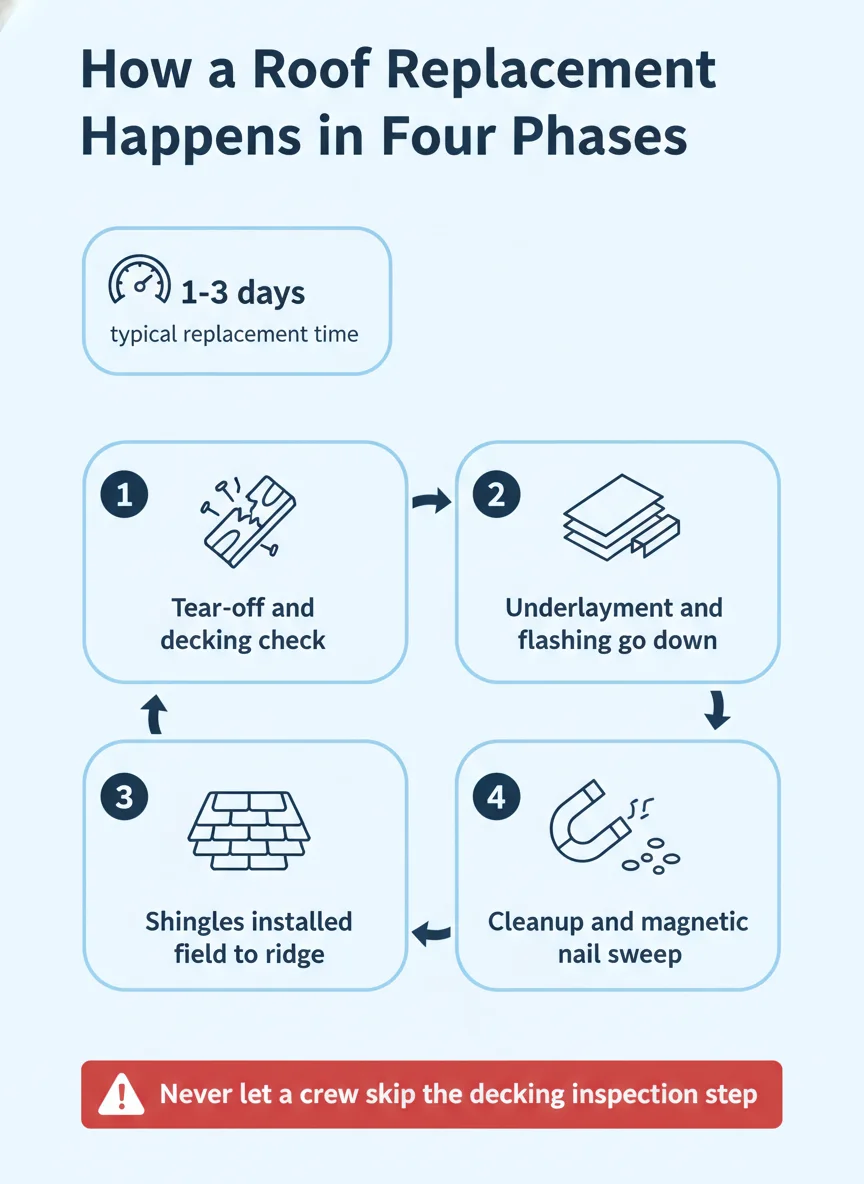
Here's the order a crew generally follows on a standard roof replacement, start to finish. Not every job hits every step in exactly this order, but this is the typical flow for a home in the Oklahoma City metro.
- Dumpster and setup: The crew drops a dumpster, protects landscaping and walkways with tarps, and stages materials on the roof or in the yard before any tear-off begins.
- Tear-off begins: Old shingles, underlayment, and flashing are stripped down to the bare wood decking, usually working from the top of the roof down in sections.
- Decking inspection: The crew checks every section of exposed decking for soft spots, rot, or old water damage, replacing any bad sections before covering them back up.
- Underlayment and ice barrier: A water-resistant barrier goes down across the whole roof, with an ice and water shield layer along eaves, valleys, and other vulnerable spots.
- Drip edge and flashing: Metal drip edge gets installed along the roof's perimeter, and flashing is cut and sealed around chimneys, vents, skylights, and sidewalls.
- Shingles and ridge cap: New shingles go on field by field, working up toward the peak, finished off with a ridge cap along the top of the roof for a clean, sealed line.
- Cleanup and nail sweep: Debris gets hauled to the dumpster, the yard is cleared, and a magnetic sweep runs across the property to pick up stray nails before the crew leaves.
What You'll See When the Crew Walks the Finished Roof
Once the shingles and ridge cap are on, a crew will typically walk the roof one more time before calling the job done. They're checking shingle alignment and nailing patterns, making sure every flashing point is sealed, and confirming vents and pipe boots are secure. This final pass is where small fixes get caught before they become a reason for a callback.
Checking the Field of the Roof
The crew looks across the shingle courses for consistent alignment and spacing, confirms nail placement is correct rather than overdriven or underdriven, and checks that the ridge vent, if the home has one, is set and sealed properly along the peak.
They'll also check valleys and any area where two roof planes meet, since those spots carry more water than a flat section and are more likely to show a problem if something was missed during installation.
Checking the Perimeter and Penetrations
Drip edge gets a visual check along every eave and rake to confirm it's fastened flat and consistent. Every pipe boot, vent, and flashing point gets a hands-on check, since these small details are the most common source of a future leak if they're rushed.
This is also the point where a crew confirms the yard is clear. A thorough magnetic sweep for nails, done more than once if the job ran multiple days, is part of leaving the property the way it was found, minus the old roof.
What You Can Handle and What's Strictly a Pro's Job
Before the crew arrives, a homeowner can handle most of the prep work themselves. That means moving vehicles, clearing patio furniture and grills away from the house, taking fragile items off walls inside since the hammering will cause vibration, and letting pets stay somewhere quiet for the day.
Everything from tear-off forward belongs to a licensed roofing crew. Working at height, cutting and sealing flashing correctly, and matching underlayment to local code requirements all take training and the right equipment. Attempting any of that without experience risks both injury and a roof that doesn't perform the way it should.
If storm damage is part of why you're replacing the roof, that adds a documentation step before tear-off even starts, since insurance adjusters often want photos of the damage in place. If that applies to your situation, it's worth reading up on storm and hail damage repair before the crew shows up so you know what to expect from that side of the process.
Getting Ready for Your Own Replacement Day
Replacement day moves fast once it starts, but it isn't random. Tear-off, decking checks, underlayment, flashing, shingles, and a final sweep, in that order, every time. Knowing the sequence means you can ask informed questions if something looks off, and relax about the parts that are completely normal, like a bare deck sitting open for a few hours mid-morning.
If you're weighing whether your roof even needs full replacement yet, it's worth reading when a roof is past repair first. Homeowners in Moore and across the metro who are ready to schedule a walkthrough can reach out to All The Way Up Construction to talk through what their specific roof will need on the day.
Frequently asked questions
How long does roof replacement day actually take?
Most houses in the Oklahoma City metro get torn off and re-roofed in one to three days, depending on the size of the roof and the weather that week. Complicated rooflines with lots of valleys or dormers tend to run toward the longer end.
Do I need to be home during the roof replacement?
You don't have to be home, but someone should be reachable by phone in case the crew finds something under the old shingles that needs a decision, like soft decking. Most homeowners come and go during the day without any issue.
What should I move before roof replacement day?
Move vehicles out of the driveway, take down anything fragile hanging on walls inside the house, and clear patio furniture or grills away from the house. Falling debris and vibration are the main reasons to clear the perimeter.
Will my yard get torn up during a roof replacement?
A good crew protects landscaping with tarps before tear-off starts and runs a magnetic sweep for nails at the end of each day. Some debris and foot traffic around the house is normal, but it shouldn't leave lasting damage.
What happens if the crew finds rotten decking during tear-off?
They stop and show you the damaged section before replacing it, since that's work beyond the original plan. This is one of the most common surprises on replacement day, and it's usually a small, fixable area rather than the whole roof.